How Banks in Latin America Ensure Compliant Customer Communications. Learn how automated workflows and CCM platforms help banks navigate complex...
Explore certified email delivery for customer communications in LATAM, a vital tool for legal proof in an evolving regulatory landscape.
When a bank sends a rate change notice, an insurer sends a policy update, or a fintech company notifies a customer of a credit decision, standard email creates no structured legal proof that the communication was delivered or read. That gap has always been a risk. In 2026, for enterprises operating in regulated LATAM industries, it is increasingly a liability.
In Latin America's tightening regulatory environment, that gap is drawing greater scrutiny. Regulators, courts, and consumer protection agencies are increasingly demanding verifiable evidence of what was communicated, to whom, and when, with enforcement postures in Brazil, Mexico, and Chile shifting from passive oversight to active sanction.
This guide explains what certified email delivery is, how it works within a customer communications platform, which LATAM regulatory frameworks implicate its use, and what to look for when evaluating the capability as part of a defensible customer communications strategy.
Quick Summary: What Is Certified Email Delivery?
Certified email delivery for customer communications is a mechanism that produces legally verifiable proof of four events in an email's lifecycle, covering sending, content integrity, delivery, and reading, and creating a tamper-resistant record with evidentiary value for regulated business communications.
Standard SMTP delivery confirms only that a message left the sender's server, not that it arrived, was intact, or was read. Certified email closes that gap by capturing each event in an independently verifiable, tamper-resistant record.
The table below maps each certification event to what is captured and why it matters in a dispute or regulatory context.
|
Certification Event |
What Is Captured |
Why It Has Evidentiary Value |
|
Sending |
Timestamp, sender identity, server reference |
Proves the communication was initiated at a specific time by an authorized party |
|
Content integrity |
Hash or copy of message body and attachments at send time |
Proves the content was not altered after sending |
|
Delivery |
Confirmation the message reached the recipient's mailbox |
Proves the recipient had access to the communication |
|
Reading |
Timestamp and device/IP record of when the recipient opened it |
Proves the recipient was exposed to the content (strongest evidentiary level) |
Under eIDAS 2.0 (Regulation EU 2024/1183, in force since May 2024), qualified electronic registered delivery services carry a legal presumption of data integrity, sending, and receipt, which represents the highest available standard for electronic communications in the EU and a model that LATAM frameworks are increasingly referencing. For enterprises building a defensible customer communications strategy, DocPath's CXM platform supports certified delivery as part of an integrated document generation and multichannel communication workflow, designed to reduce the evidentiary chain gaps that arise when delivery is treated as a bolt-on.
Why Does Certified Email Matter for Customer Communications in 2026?
In 2026, the legal and regulatory cost of unverifiable customer notifications has increased significantly across Latin America, as banks, insurers, and fintechs that cannot produce certified proof of what a customer was told face regulatory sanctions, lost disputes, and fraud exposure.
The core problem with standard email is architectural. SMTP protocols confirm server-to-server transmission only; they provide no proof of content, delivery to the recipient's mailbox, or whether the message was read. For a billing dispute, a credit decision challenge, or a regulatory examination, that gap is often fatal to an enterprise's legal position.
The regulatory pressure to close that gap is mounting across every major LATAM jurisdiction:
- Regulatory drivers in LATAM: Brazil's LGPD Article 37 imposes record-keeping obligations on controllers that effectively require documented proof of customer communications; Mexico's NOM-151-SCFI-2016 establishes technical requirements for electronic message preservation and timestamping in commercial transactions; Chile's Law 19,799 (updated 2022) grants legal validity to electronic documents meeting defined technical standards; and Colombia's Law 527/1999 governs the legal validity of data messages in electronic commerce. Between 2023 and 2025, Brazil's data protection authority ANPD issued fines totaling approximately BRL 98 million (roughly USD 20 million), targeting the finance, healthcare, and AI-processing sectors, and has signaled continued enforcement escalation through its 2025-2026 regulatory agenda.
- Use case triggers: Credit decision notices, billing dispute notifications, policy change communications, contractual amendment alerts, and account closure notices all require defensible delivery proof. In each of these scenarios, a customer's claim that they were not notified is structurally stronger when the sending enterprise cannot produce a certified evidence record.
- Court and arbitration context: In banking and insurance disputes across Brazil, Mexico, and Chile, the party that cannot produce verified delivery evidence is at a structural disadvantage, regardless of whether the underlying decision was correct. Consumer protection agencies including BACEN and PROCON in Brazil, CONDUSEF in Mexico, and CMF in Chile increasingly require documented delivery evidence as a condition of favorable dispute resolution outcomes.
- The regulatory trend: Across LATAM financial sectors, regulators are shifting from asking "did you send it?" to demanding "can you prove the customer received it in the correct form?" The LATAM fintech ecosystem has grown to more than 3,000 companies, representing a 340% increase since 2017, with Brazil, Mexico, and Colombia accounting for more than half of that market, and regulators in all three countries are actively increasing compliance scrutiny to match that scale.
Evidentiary gap callout: Standard email provides no structured, independently verifiable evidentiary record of delivery or reading in any LATAM jurisdiction. It can show that a message was composed and transmitted at the server level, and nothing more. Regulated enterprises that rely on standard email for compliance notifications are carrying an evidentiary gap that can become decisive in disputes and regulatory examinations.
How Does Certified Email Delivery Work? (Step-by-Step)
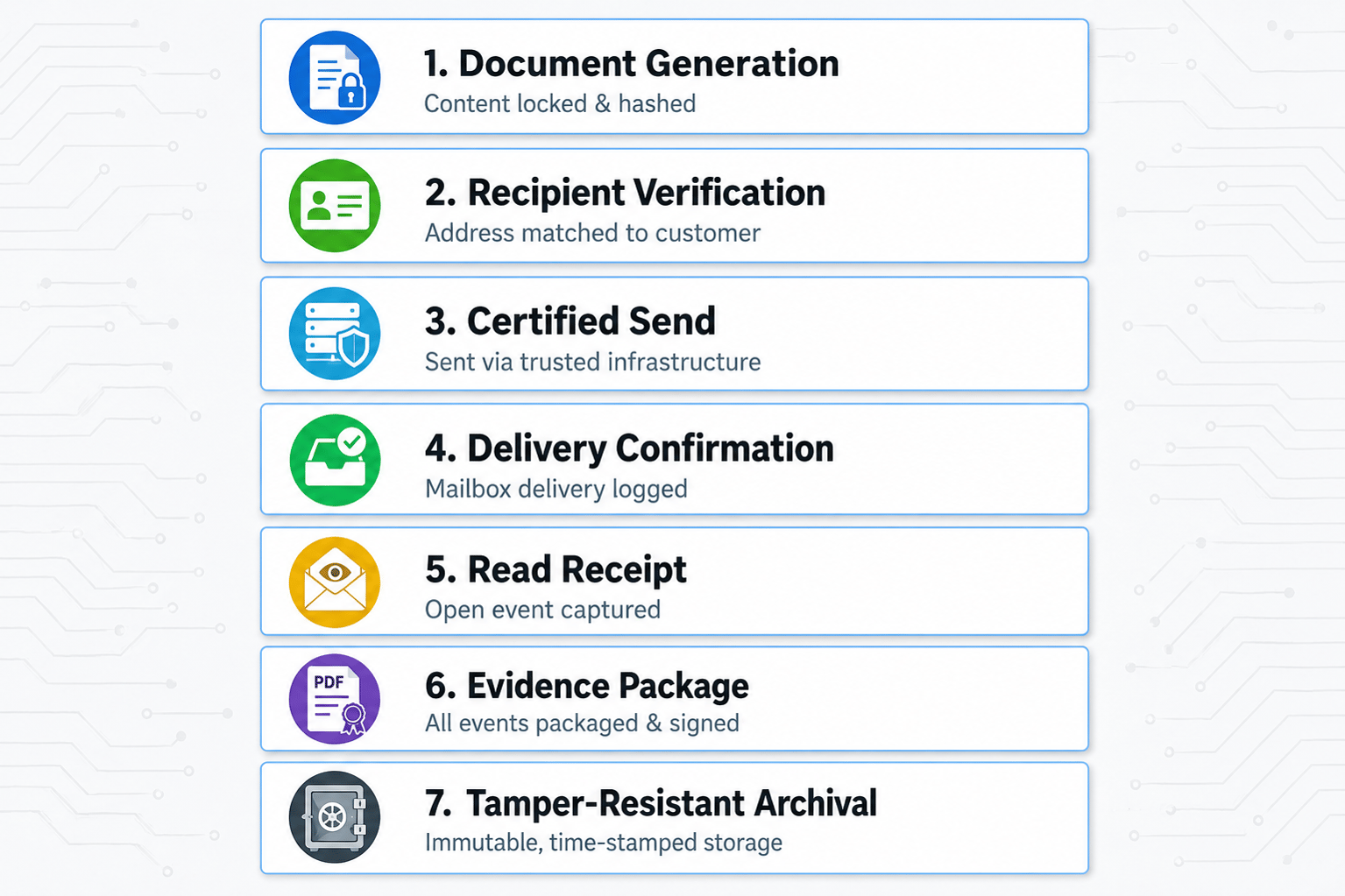
Certified email delivery works through a seven-step chain running from document generation through trusted third-party certification to tamper-resistant evidence storage, and every link in that chain must be intact for the record to hold evidentiary value.
The process is not simply a delivery receipt. It is a documented, independently verifiable account of a communication's entire lifecycle, structured to survive scrutiny in legal proceedings and regulatory examinations. Here is how each step works in a correctly architected certified delivery workflow.
- Document generation with version lock. The customer communication is generated from an approved template with a locked content version. The hash of the document is recorded at this stage, creating a pre-delivery fingerprint. This is critical: if the content hash recorded at generation does not match the hash at delivery, the evidentiary chain is broken. DocPath's document generation engine is designed to support this version-locking within the same platform, enabling the generation and delivery steps to share a consistent evidence record; contact DocPath to discuss how this applies to your specific deployment configuration.
- Recipient identity verification. The email address is confirmed against a verified customer record before sending. An unverified address breaks the evidentiary chain at the recipient identity link: if the enterprise cannot prove that the email address belongs to the customer, delivery confirmation has limited evidentiary value. This step is particularly important in the LATAM context, where financial consumer protection agencies require that notification reach the specific individual named in the communication.
- Certified send via trusted infrastructure. The message is transmitted through a certified sending infrastructure, whether an accredited trust service provider or internal infrastructure with equivalent logging capabilities. A send timestamp and message ID are recorded. Under eIDAS Article 43, a registered delivery service cannot be denied legal effect or admissibility as evidence solely because it is not qualified, meaning that well-documented non-qualified infrastructure can still produce legally valid records.
- Delivery confirmation capture. Delivery to the recipient's mailbox is confirmed at the MTA (mail transfer agent) level, with server response codes and timestamps recorded and stored independently of the sending system. This step proves the recipient had access to the communication, which is distinct from proving the recipient read it, which requires the next step.
- Read receipt recording. When the recipient opens the email, a read event is captured including timestamp, IP address, device identifier, and browser or client information. This is stored in the immutable evidence record. Read confirmation is the strongest evidentiary level, as it proves not just that a message arrived, but that the recipient was exposed to its content, supporting the argument that the customer was meaningfully informed.
- Evidence package generation. All four events (send, content, delivery, and reading) are assembled into a structured evidence package. This is typically a signed PDF containing hashes, timestamps, and delivery metadata, formatted to be produced in a dispute, audit, or regulatory examination. ETSI EN 319 522 (updated 2024) defines the reference standards for qualified electronic registered delivery services and the format requirements for evidence packages submitted under European frameworks, representing the same architecture that leading CCM providers are now applying across LATAM deployments.
- Tamper-resistant archival. The evidence package is stored in immutable, time-stamped custody using WORM storage or a cryptographic equivalent, with a documented retention period aligned to applicable regulatory requirements. An evidence package stored where operational staff can modify or delete it does not meet tamper-resistance requirements; independent, immutable custody is the minimum acceptable standard.
Want to integrate certified email delivery into your document generation workflow? Contact DocPath to discuss your requirements.
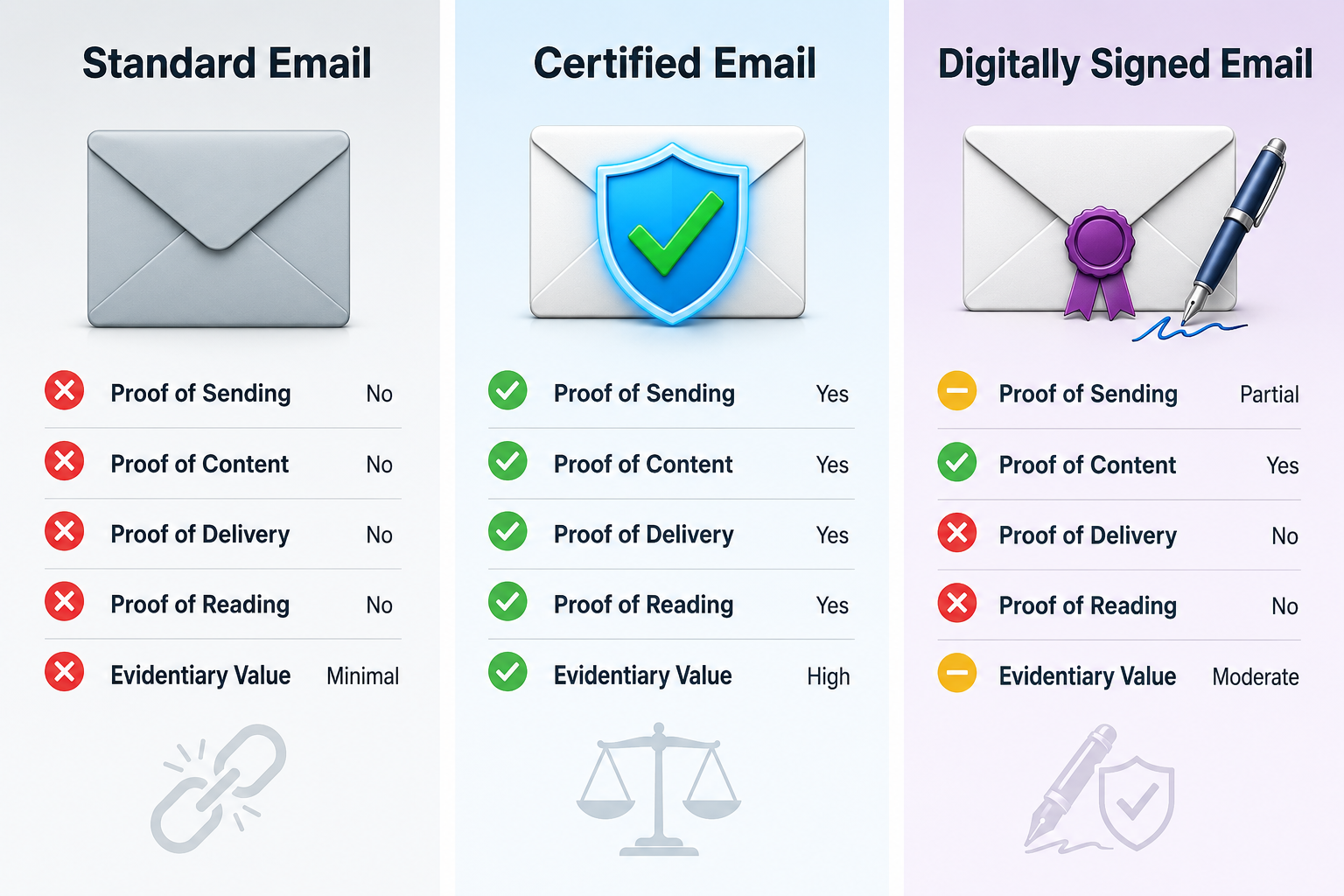
Certified Email vs. Standard Email vs. Digital Signature: What's the Difference?
Certified email, standard email, and digitally signed email serve different evidentiary functions, and using the wrong one for a regulated customer communication creates a compliance gap even when the content itself is correct.
Understanding the distinction is not a technicality; it has direct consequences for dispute outcomes and regulatory examinations. A digital signature proves that a document's content was not altered after signing, focusing on content integrity. A certified email proves that a specific recipient received and opened a specific message at a specific time, focusing on the delivery and receipt events. Standard email, governed only by SMTP, proves neither. The three mechanisms serve different evidentiary needs and are complementary rather than interchangeable.
The most defensible approach for regulated communications uses both certified delivery and digital signatures together: the digital signature proves content integrity, and the certified delivery record proves receipt. DocPath's platform supports both capabilities, integrated into a single multichannel delivery workflow.
|
Attribute |
Standard Email |
Certified Email |
Digitally Signed Email |
|
Proof of sending |
No structured proof |
Yes, timestamped and logged |
Partial (signature timestamp only) |
|
Proof of content at send time |
None |
Yes (content hash captured) |
Yes (signature covers content) |
|
Proof of delivery |
None (SMTP status only) |
Yes (delivery confirmation logged) |
None |
|
Proof of reading |
None |
Yes (read event with IP/device/timestamp) |
None |
|
Evidentiary value in disputes |
Minimal / none |
High: structured evidence package |
Moderate, covering content but not receipt |
|
Regulatory use case |
Low-stakes communications |
Regulated notifications (banking, insurance) |
Document execution (contracts, consents) |
|
LATAM legal framework |
None specific |
ICP-Brasil, NOM-151, Chile Law 19,799 |
ICP-Brasil, FIEL (Mexico), Chile Law 19,799 |
eIDAS distinguishes explicitly between electronic signatures (Articles 25-26, covering content integrity) and electronic registered delivery services (Articles 43-44, covering transmission and receipt); the two functions are legally separate and neither substitutes for the other in a regulated notification context. LATAM frameworks follow the same structural logic: ICP-Brasil covers digital certificates and signatures, while NOM-151 addresses electronic message preservation and timestamping as a distinct legal function.
For practical guidance on DocPath's approach to digitally signed and notarized documents, see DocPath Secure and Notarized Digital Signatures.
Which LATAM Regulations Require or Imply Certified Email Delivery?
No single Latin American regulation mandates certified email by name, but the documentation and accountability obligations in Brazil's LGPD, Mexico's CNBV and NOM-151 framework, Chile's Law 19,799, and Colombia's Law 527/1999 collectively create a strong implicit requirement for enterprises to use certified delivery for regulated customer notifications.
The regulatory picture across Latin America is not a single mandate but rather a convergence of record-keeping obligations, consumer protection standards, and electronic commerce frameworks that, taken together, make certified delivery the most defensible architectural approach for enterprises sending high-stakes customer notifications. The table below summarizes the key frameworks by country before the detailed sub-sections that follow.
|
Country |
Primary Framework |
Key Obligation |
Relevant Authority |
|
Brazil |
LGPD Art. 37 + ICP-Brasil + BACEN |
Record-keeping, data subject rights, financial notification documentation |
ANPD, BACEN |
|
Mexico |
NOM-151-SCFI-2016 + CNBV circulars |
Electronic message preservation, timestamping, financial consumer notification |
SE, CNBV, CONDUSEF |
|
Chile |
Law 19,799 (updated 2022) |
Legal validity of electronic documents and signatures |
CMF, SII |
|
Colombia |
Law 527/1999 |
Legal validity of data messages in electronic commerce |
SIC |
|
Argentina |
Law 25,506 |
Digital signature framework |
Ministerio de Justicia |
Multinationals operating across LATAM face overlapping and sometimes inconsistent requirements. A single certified email architecture that meets the highest common standard across jurisdictions is more efficient than jurisdiction-specific bolt-ons, a point directly addressed by DocPath's multi-country LATAM deployment model.
Brazil: ICP-Brasil and LGPD
Brazil's Provisional Measure 2,200-2/2001 established ICP-Brasil as the legal framework for electronic documents and digital certificates, giving certified electronic communications legal validity equivalent to paper, while LGPD Article 37 creates record-keeping obligations that create a strong basis for enterprises to document regulated customer communications in a verifiable form.
ICP-Brasil defines a certificate hierarchy administered by the Instituto Nacional de Tecnologia da Informação (ITI), within which timestamping and delivery certification services operate as distinct trust functions from digital signatures. Under LGPD, Article 37 mandates that controllers maintain records of data processing activities, which extends in practice to documentation of how customer communications are generated, delivered, and evidenced. The ANPD has made clear through its 2025-2026 regulatory agenda that financial sector compliance, including the documentation of customer data processing events, will remain a priority for enforcement. LGPD penalties can reach up to 2% of a company's Brazilian revenue, capped at BRL 50 million per violation.
Mexico: NOM-151 and CNBV Framework
Mexico's NOM-151-SCFI-2016 establishes technical requirements for electronic message preservation and timestamp services, providing the legal basis for certified email in commercial and financial transactions, and CNBV circulars add sector-specific notification requirements for regulated financial institutions.
NOM-151, administered by the Secretaría de Economía, requires that digital timestamps and electronic message preservation services meet documented technical standards, and it provides the legal infrastructure for certified electronic records in Mexican commerce. CNBV circulars complement this framework with specific obligations for credit institutions, including documentation requirements for credit decision communications, product term changes, and fee disclosures. CONDUSEF, Mexico's financial consumer protection agency, increasingly demands delivery evidence from financial institutions in dispute resolution proceedings, making certified delivery records directly relevant to regulatory outcomes (https://fintech.global/2025/01/30/the-essential-role-of-compliance-in-latams-booming-fintech-sector/).
Chile, Colombia, Argentina, and Emerging Frameworks
Chile's Law 19,799 (updated in 2022) provides broad legal validity to electronic documents and digital signatures; Colombia's Law 527/1999 covers data messages in electronic commerce; Argentina's Law 25,506 governs digital signatures, and all three create legal infrastructure that supports certified email delivery, but with different technical requirements.
Chile's 2022 update to Law 19,799 expanded the legal validity of electronic documents and strengthened the evidentiary presumption for electronically signed and delivered communications, with CMF (Comisión para el Mercado Financiero) providing sector-specific overlay requirements for financial services. Colombia's Law 527/1999 grants legal validity to data messages meeting functional requirements for writing, signature, and originals, and certified email satisfies these requirements when the evidence chain is intact. Argentina's Law 25,506 establishes the framework for digital signatures and their equivalence to handwritten signatures, with the Ministerio de Justicia overseeing the certification authority infrastructure. The divergence across these five jurisdictions underscores the need for an adaptable certified delivery architecture, one that aligns to the highest common standard rather than the lowest.
DocPath operates across Brazil, Mexico, Chile, and beyond. Talk to our team about certified email delivery aligned to your country-specific regulatory requirements.
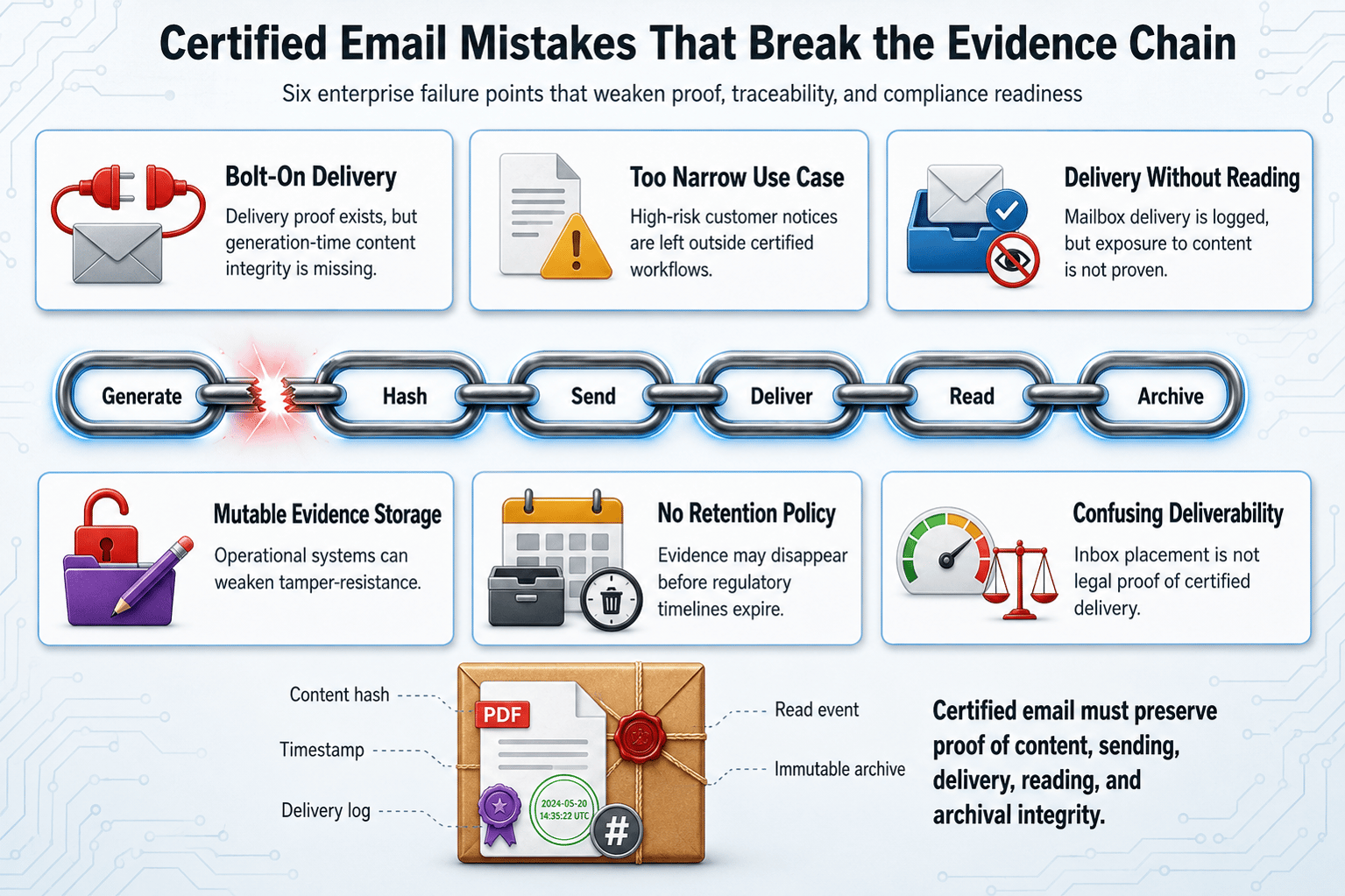
What Are the Biggest Mistakes Enterprises Make with Certified Email for Customer Communications?
The most common enterprise mistake is implementing certified delivery as a standalone bolt-on, separate from the document generation platform, which breaks the evidentiary chain at the content integrity link and creates exactly the traceability gap that certification was meant to close.
Certified email is not a feature that can be added to an existing communication workflow without architectural consideration. The six mistakes below represent the most consistently observed failure patterns in enterprise certified email deployments across regulated LATAM industries.
- Treating certified email as a delivery tool, not a compliance workflow. Certified email only provides complete evidentiary value when the content hash recorded at document generation and the content hash recorded at delivery match. A bolt-on certified delivery service attached after document generation cannot guarantee this chain, because it has no access to the generation-time hash. The evidence package produced by a bolt-on system can prove that something was delivered, but not that the thing delivered matches what was approved and generated. For compliance purposes, this distinction is decisive.
- Using certified email only for legally mandated notifications while ignoring high-risk discretionary communications. Credit decisions, account access changes, and product term modifications create dispute exposure even when no specific regulation explicitly mandates certified delivery for that communication type. Enterprises should define a risk-tiered notification policy that assigns certified delivery to any communication where the enterprise's inability to prove receipt would create a defensible customer claim, not just those where a specific statute requires it.
- Failing to capture read events, relying only on delivery confirmation. Delivery confirmation proves that the customer's mailbox received the message; it does not prove that the customer saw it. Read confirmation, capturing IP address, device identifier, and timestamp, proves exposure to content. For the strongest evidentiary position in a dispute, particularly before CONDUSEF, BACEN, or CMF, and both events must be captured and stored. Enterprises that stop at delivery confirmation are leaving the most powerful element of their evidentiary record uncaptured.
- Storing evidence packages in the same mutable system as operational data. An evidence package stored where operational staff can modify or delete it does not meet tamper-resistance requirements under any LATAM or European certified delivery standard. Immutable, independently accessible storage, specifically WORM storage or a cryptographic equivalent, is the minimum. The integrity of the evidence record is the entire point; compromising it through inadequate storage architecture negates the value of capturing the events in the first place.
- No retention policy on certified email evidence. Evidence packages that are deleted before applicable regulatory retention periods expire create the same compliance gap as never certifying in the first place. Under LGPD Resolution CD/ANPD No. 15 (April 2024), incident registries must be maintained for a minimum of five years, a standard that reflects the regulatory direction across the region. Retention must be governed by the same policies as other compliance records, with jurisdiction-specific retention periods applied by communication type.
- Confusing email deliverability optimization with certified email delivery. Improving inbox placement rates is an email marketing function focused on sender reputation and ISP filtering. Certified email delivery is a legal compliance function that creates verifiable proof of sending, content, delivery, and reading. The two capabilities have nothing in common architecturally. Conflating them leads to misaligned investments: improving deliverability scores while the compliance gap remains unaddressed, and critically to genuine regulatory exposure when an enterprise believes its deliverability improvements have satisfied a legal obligation they have not touched.
Certified Email Delivery in Regulated Latin American Industries
Banking, insurance, fintech, and government are among the highest-risk sectors for unverifiable customer notifications in Latin America. In each sector, failed or disputed delivery can create regulatory, legal, or financial exposure, making certified email a practical way to preserve evidence of what was sent, when it was sent, and whether it reached the recipient.
Banking and Financial Services
Banks must be able to prove that credit decisions, account changes, rate adjustments, fee disclosures, and regulatory notices were communicated to customers in the required form. When a customer disputes a charge, credit-limit reduction, loan denial, or fee change, certified email provides a verifiable delivery record that helps the institution demonstrate that the notification was sent and received.
This is especially relevant in markets such as Brazil and Mexico, where financial institutions operate under strict consumer-protection and documentation expectations. In dispute proceedings, a bank that cannot produce reliable notification evidence may face greater regulatory, legal, and reputational risk.
Insurance
Insurance companies face similar exposure around policy issuance, premium changes, endorsements, renewal notices, and cancellations. If a policyholder claims they were not notified of a cancellation, premium increase, or policy change, the insurer’s position depends heavily on whether it can prove delivery.
Certified email helps insurers preserve a defensible record of customer communications, reducing the risk that coverage disputes turn on unverifiable notification claims rather than the underlying policy terms.
Government and Public Services
Government agencies and public-service providers increasingly rely on electronic communications for official notices, administrative updates, citizen services, and procedural notifications. When these communications affect rights, deadlines, benefits, permits, or obligations, attempted delivery is not enough; the institution must be able to demonstrate that the notice was delivered through a traceable process.
Certified email supports digital-first public communication by creating a legally useful evidence trail for official notifications, while reducing dependence on manual delivery records or ordinary email logs.
Why Accessible Certified Emails Are the Next Compliance Frontier
A certified email that the recipient cannot access because the attached document is not accessible to screen readers or assistive technologies, may satisfy delivery requirements but fails the broader communication obligation: that the customer was meaningfully informed, not just technically notified.
Certification proves the email reached the recipient's inbox and was opened. Accessibility standards such as PDF/UA for document content and WCAG 2.1 AA for digital interfaces ensure the content of the certified document was actually usable by all recipients. The two dimensions are inseparable in any complete compliance posture.
- LGPD and GDPR intersection: Because organizations cannot ask customers whether they have a disability, they cannot selectively send accessible documents, so all customer communications must be accessible by default. Certified delivery should log the accessibility standard of the document delivered, not just its arrival. The combination of an inaccessible document and a certified delivery record creates a paradox: the enterprise can prove it communicated, but cannot prove it meaningfully informed.
- DocPath's integrated approach: DocPath's platform is designed to support PDF/UA-compliant accessible document generation alongside certified email delivery within the same workflow, with the goal of enabling a single audit record that captures both the accessibility standard of the delivered document and the delivery events. Contact DocPath to discuss how this applies to your specific implementation.
The 2026 compliance frontier is not just "did the customer receive it?" but "could the customer use it?" Enterprises that do not address both questions in the same workflow are carrying a compliance gap they may not yet have quantified.
How DocPath Delivers Certified Email Within the Customer Communications Platform
DocPath's CXM platform includes the capability to send notifications and emails with full evidentiary value, designed to work within an integrated document generation and multichannel delivery workflow, with the goal of supporting an evidence chain from template approval through certified delivery to tamper-resistant archival, on a platform certified under ISO 27001 and SOC 2. Enterprises should contact DocPath directly to discuss the specific certified delivery capabilities available for their use case and jurisdiction.
The architectural case for integration over bolt-on certified delivery is a principle that applies across vendors, not only DocPath: when document generation and certified delivery operate in separate systems, the content integrity link in the evidentiary chain depends on that integration being correctly configured and maintained. Here is how DocPath approaches this within its platform:
- Integrated delivery architecture: Document generation, certified email delivery, and evidence archival are designed to operate within one platform, reducing the integration gaps between generation and delivery that can weaken the evidentiary chain. The aim is that the content hash recorded at generation aligns with the hash verified at delivery; verify the specific technical implementation with DocPath for your deployment.
- Multichannel scope: Certified delivery extends across email, SMS, WhatsApp, and print, all within one traceable platform. Each channel's delivery events are captured in the unified evidence record, so a communication that begins as an email and is followed up via SMS leaves a single, coherent evidentiary trail.
- Deployment model: All DocPath deployments follow an on-premises or private cloud model, meaning client data never leaves the customer's own environment. This is critical for LGPD and CNBV data residency requirements, where personal data processed as part of customer communications must remain within the defined jurisdictional boundary.
- Certifications: ISO 9001, ISO 27001, and SOC 2 provide the institutional compliance assurance that enterprise legal and IT teams require when selecting a platform that will hold legally sensitive evidence records. These certifications are documented at DocPath's certifications page.
- LATAM presence: DocPath maintains offices and a partner network in Brazil, Mexico, and Chile, with local support and jurisdiction-specific implementation guidance, which is a meaningful differentiator for enterprises navigating country-specific regulatory requirements across multiple jurisdictions simultaneously.
- Integration: The platform connects with ERP, CRM, and core business systems, so certified delivery events are tied to the business data that generated the communication, creating a complete evidentiary context that links the notification back to the originating business event.
For current feature details and certified delivery capabilities available for your specific use case and jurisdiction, contact DocPath directly.
Certified Email Delivery Evaluation Checklist
Use this checklist to ensure a certified email delivery solution meets the evidentiary, architectural, and regulatory demands of enterprise customer communications, particularly across multi-country Latin American operations.
When evaluating a certified email delivery capability, whether as a standalone service or as part of a broader CCM platform, every item on this checklist represents a requirement whose absence creates a verifiable compliance gap. Use it in vendor evaluation, internal architecture review, and audit preparation.
☐ Complete evidentiary chain: Sending, content integrity, delivery, and reading, with all four events captured and stored.
☐ Content hash recorded at document generation, and not only at send, to prove the document was not altered between generation and delivery.
☐ Certified send via accredited or auditable trusted infrastructure aligned to ICP-Brasil, NOM-151, or eIDAS as applicable to your operating jurisdictions.
☐ Tamper-resistant evidence package storage using WORM, cryptographic hash, or equivalent immutable custody.
☐ Read event capture: IP address, device identifier, and timestamp, not just delivery confirmation.
☐ Native integration with document generation platform, with no middleware gap in the evidentiary chain between generation and delivery.
☐ Retention policy management: Configurable by communication type and jurisdiction, with minimum five-year retention for LGPD-governed records.
☐ Accessible document delivery: PDF/UA-compliant content certified as part of the same delivery record.
☐ Multichannel coverage: Email, SMS, WhatsApp, and print, all captured in a unified evidence record.
☐ Role-based access to evidence records, with access events logged.
☐ Export capability for regulatory evidence packages as a signed PDF or CSV with chain-of-custody metadata.
☐ LATAM regulatory alignment verified: ICP-Brasil, NOM-151, Chile Law 19,799, Colombia Law 527, LGPD.
☐ Vendor certifications: ISO 27001 and SOC 2 Type II minimum for regulated enterprise use.
Ready to check every box? Contact DocPath for a personalized consultation on certified email delivery for your customer communications program.
Frequently Asked Questions
What is certified email delivery for customer communications?
Certified email delivery is the process of sending business-critical customer communications with legally verifiable proof of four events: sending (with timestamp and sender identity), content integrity (the exact message content at send time), delivery (confirmation the email reached the recipient's mailbox), and reading (confirmation the recipient opened it). Unlike standard email, it produces a structured evidence package, typically a signed, timestamped PDF that can be presented in a dispute, regulatory examination, or legal proceeding.
Is certified email delivery legally required for customer communications in Latin America?
No single Latin American regulation mandates certified email by name, but the record-keeping obligations under Brazil's LGPD, Mexico's NOM-151 framework and CNBV circulars, Chile's Law 19,799, and Colombia's Law 527/1999 collectively create a strong practical requirement for enterprises to use certified delivery for regulated notifications, particularly in banking, insurance, and fintech. Enterprises should verify specific obligations with local legal counsel and official regulatory sources, as requirements continue to evolve.
Key frameworks:
- Brazil: LGPD Art. 37 + ICP-Brasil + BACEN consumer notification requirements
- Mexico: NOM-151-SCFI-2016 + CNBV circulars
- Chile: Law 19,799 on electronic documents (updated 2022)
- Colombia: Law 527/1999 on data messages in electronic commerce
What is the difference between certified email and email with a digital signature?
Certified email proves that a specific recipient received and opened a specific message at a specific time, focusing on the delivery and receipt events. A digital signature proves that a document's content was not altered after signing, focusing on content integrity. They address different evidentiary needs and are complementary: digitally signed documents delivered via certified email provide both content integrity and verified receipt. Standard email provides neither.
What is the difference between certified email delivery and email deliverability?
Email deliverability refers to the likelihood that a marketing or transactional email will reach the recipient's inbox rather than the spam folder; it is an optimization function focused on inbox placement rates, sender reputation, and ISP filtering. Certified email delivery is a legal compliance function that creates verifiable proof of sending, content, delivery, and reading. They are separate capabilities that serve entirely different purposes; improving inbox placement rates does not provide any legal proof of delivery.
What happens if an enterprise cannot prove a regulated customer notification was delivered?
In a dispute or regulatory examination, the inability to produce verified delivery evidence typically places the enterprise in a structurally disadvantaged position, as the burden of proof shifts, and the customer's claim that they were not notified becomes harder to refute. In financial services, this can result in unfavorable dispute resolution outcomes, regulatory sanctions, and reputational damage. Penalty severity varies by jurisdiction and communication type, so verify current regulatory enforcement posture from BACEN, CNBV, CMF, or ANPD.
Can DocPath's platform send emails with full evidentiary value?
Yes. DocPath's solutions page confirms the platform capability to "send notifications and emails with full evidentiary value" as a native feature, integrated within the same CCM platform as document generation, multichannel delivery, and audit trail management. The platform is certified under ISO 27001 and SOC 2. Enterprises should contact DocPath directly to discuss the specific certified delivery capabilities available for their use case and jurisdiction.
Does accessible document delivery matter for certified email compliance?
Yes, and it is an increasingly important intersection. A certified email proves the document reached the recipient and was opened, but if the document itself is not accessible to recipients with disabilities (for example, a non-PDF/UA-compliant PDF that is unreadable by screen readers), the communication objective may not be met even if the delivery is legally certified.
The European Accessibility Act (enforcement began June 28, 2025) and various LATAM accessibility requirements create an obligation for accessible-by-default document delivery. Because LGPD and GDPR prohibit asking customers about disabilities, enterprises cannot selectively send accessible documents, so all certified communications should meet accessibility standards, and the audit record should log this.