
Discover how Customer Communications Management (CCM) enhances brand consistency, compliance, and customer experience for enterprise companies. Learn...
Discover the essentials of customer communications governance for regulated industries, ensuring compliance, and traceability in every interaction.
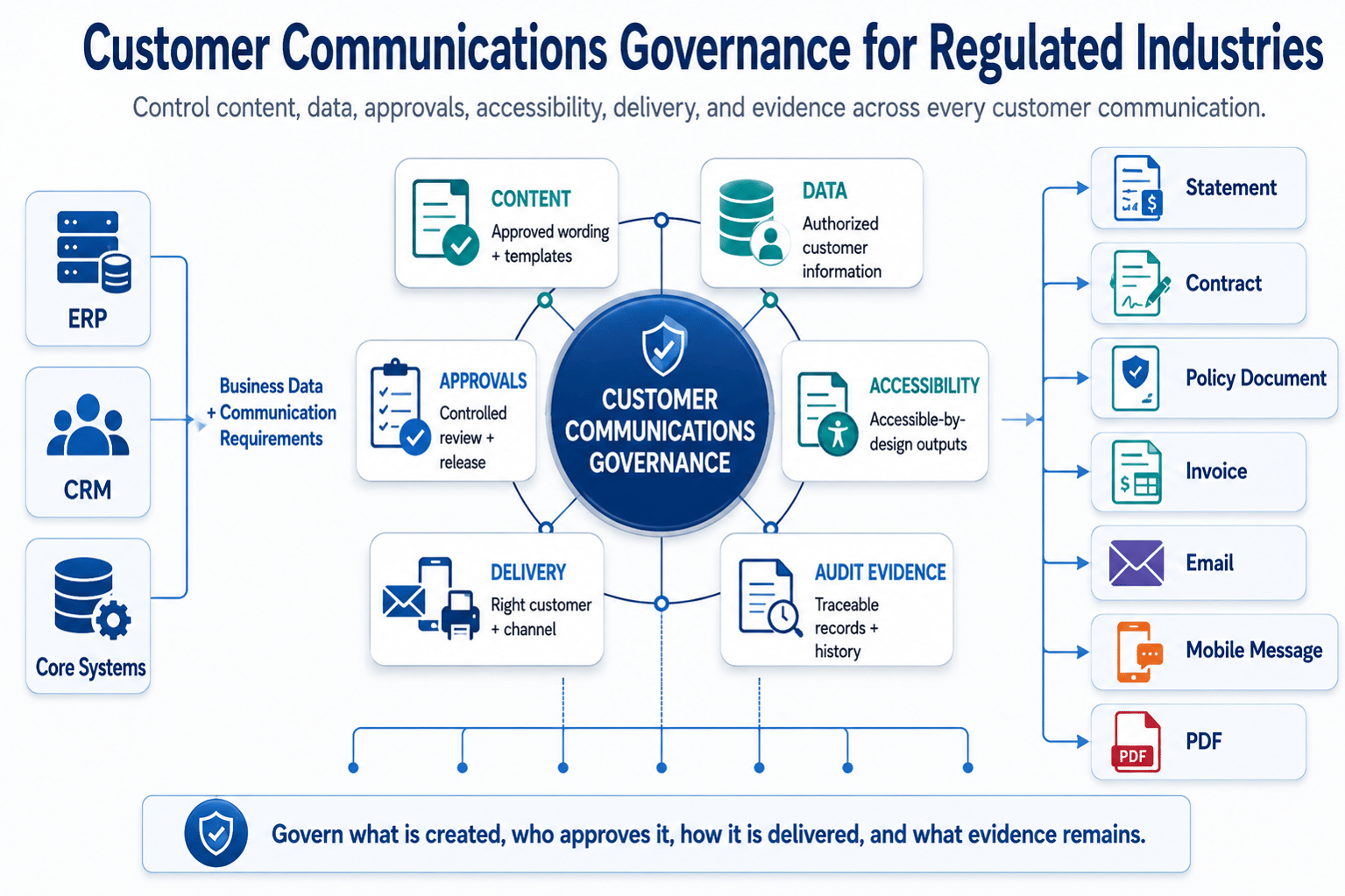
Customer communications governance is the control layer that determines whether regulated customer-facing documents and messages are accurate, authorized, traceable, accessible, and appropriate for the jurisdiction in which they are used. For regulated organizations, the question is not simply whether a statement, notice, contract, invoice, policy document, email, or message looks correct, but whether the organization can demonstrate how that communication was created, approved, generated, delivered, and retained.
This is becoming increasingly important as customer communications move across more systems and digital channels. In 2024, 37% of adults in Latin America and the Caribbean had a mobile money account, up from 22% in 2021, illustrating how quickly customer interactions involving financial data are shifting into digitally enabled environments.
At DocPath, we view customer communications governance as a lifecycle problem rather than a final-document problem. A document may contain the correct wording and still create risk if an outdated version was used, the wrong data populated it, an unauthorized person changed it, an accessibility requirement was missed, or the organization cannot later reconstruct what happened.
For a deeper look at the software layer behind these workflows, see our guide to Customer Communications Management and why enterprises use it.
Quick Summary
Customer communications governance is the system of policies, roles, controls, and evidence used to keep regulated customer-facing documents and messages accurate, approved, traceable, accessible, and compliant. Use it when communications span multiple teams, channels, products, or jurisdictions. A strong framework centralizes ownership, templates, approvals, version history, delivery records, and retention. The caveat is that controls must still map to each applicable law and regulator.
In practical terms, an effective governance model should answer five questions before and after every important communication:
- Is this the approved content and template?
- Is the correct customer data being used for the permitted purpose?
- Did the right people review and approve the communication?
- Was the correct version generated and delivered through the appropriate channel?
- Can the organization prove what happened afterward?
This governance layer becomes especially important when one organization operates across different LATAM jurisdictions. Mexico enacted a new Federal Law on Protection of Personal Data Held by Private Parties on March 20, 2025, while Peru's new personal data protection regulation entered into force on March 31, 2025.
What Is Customer Communications Governance?
Customer communications governance is the framework used to decide how customer-facing communications are created, approved, personalized, changed, delivered, retained, and evidenced. Governance connects policies and regulatory obligations to operational controls that employees and systems can consistently follow.
It is useful to distinguish governance from related disciplines. Customer Communications Management, or CCM, focuses on designing, generating, personalizing, and distributing customer-facing documents and messages across channels. DocPath describes CCM as a centralized layer between enterprise systems such as ERP, CRM, policy administration, or core banking platforms and the communications ultimately received by customers.
Governance is broader. It defines what the CCM process is allowed to do and under what conditions.
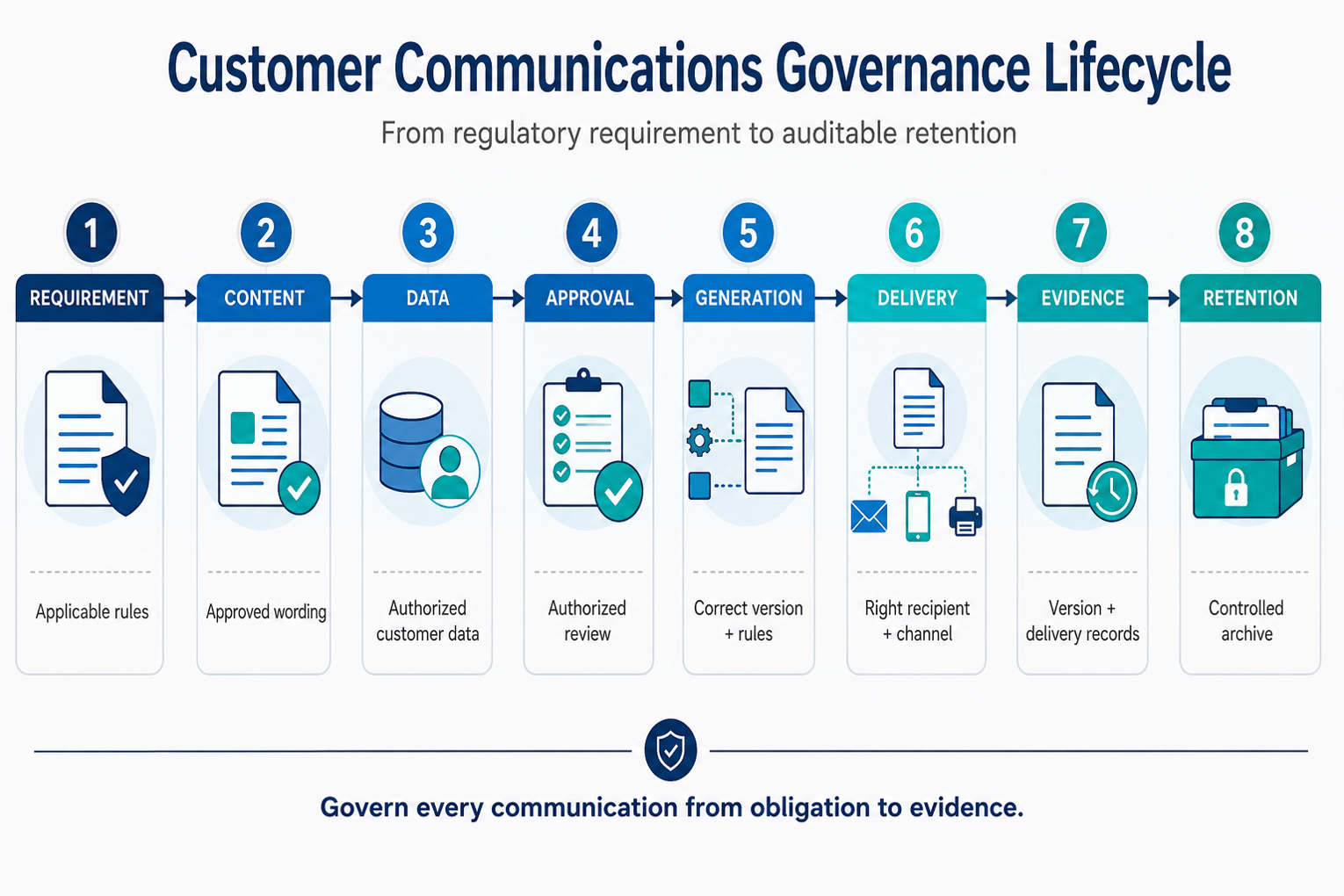
A practical communications governance lifecycle is:
Requirement → Content → Data → Approval → Generation → Delivery → Evidence → Retention
Each stage answers a different control question:
- Requirement: Which legal, regulatory, contractual, accessibility, or internal rule applies?
- Content: Which wording, disclosure, clause, branding, and language are authorized?
- Data: Which customer and transaction data may populate the communication?
- Approval: Who has authority to approve or change it?
- Generation: Which version and rules were used to produce the output?
- Delivery: Which channel and delivery conditions apply?
- Evidence: What records prove what happened?
- Retention: How long should the communication and associated metadata remain available under the applicable rules?
Customer communications governance therefore overlaps with data governance, content management, information security, accessibility, records management, and regulatory compliance, but it is not identical to any of them. The value comes from connecting those disciplines around the communication lifecycle rather than operating them as isolated controls.
Why Does Governance Matter More in Regulated Industries?
Regulated organizations have to control more than the words inside a communication. Data usage, customer rights, approval history, timing, delivery, accessibility, recordkeeping, and jurisdiction-specific obligations can all affect whether a communication is defensible.
The regulatory environment also produces significant operational activity. In 2025, Brazil's National Data Protection Authority, ANPD, reported opening 81 enforcement procedures and answering 12,701 requests from data subjects.
In another 2025 action, 20 large companies completed corrective measures after ANPD scrutiny concerning the appointment of data protection officers and the availability of effective communication channels for data subjects.
The security context adds another layer. In its 2026 Threat Intelligence Index, IBM X-Force found that Latin America accounted for 9% of the incident-response cases it analyzed for 2025. More relevant to communications governance than the regional share is what attackers were after: across all regions, credential harvesting was the single most common impact at 26% of observed cases, followed by data leaks at 19%. In Latin America specifically, credential harvesting was the leading impact, with finance and energy the most affected sectors. Globally, finance and insurance accounted for 27% of incidents in 2025, up from 23% the year before.
Communications containing account, policy, health, credit, identity, transaction, or other personal information sit within that same control environment, and cannot be treated casually.
Common governance failures include:
- An outdated disclosure remains active after a regulatory change.
- A template is changed outside the approved workflow.
- Sensitive information appears in a field that should not be exposed.
- The correct document is sent through the wrong channel.
- A communication cannot be linked to the approval that authorized it.
- A document is inaccessible to customers using assistive technology.
- An organization retains the final PDF but not enough metadata to determine which version, data, or rules created it.
These risks are particularly relevant in banking, insurance, healthcare, utilities, government, and other sectors where communications can affect financial outcomes, legal rights, access to services, or the handling of sensitive information.
For a sector-specific example, our guide to compliant banking communications in Latin America examines the intersection of document workflows, data protection, accessibility, and multichannel communication in financial services.
Which Customer Communications Should Be Governed?
Any customer-facing communication that can affect a legal right, financial outcome, contractual obligation, privacy interest, customer decision, or regulatory disclosure should enter a defined governance framework. Lower-risk communications can use lighter controls, but they should not automatically be excluded simply because they are labeled "marketing" or "informational."
Common governed communication types include:
- Account statements and transaction notices.
- Bills and invoices.
- Insurance policies and endorsements.
- Claims decisions and status letters.
- Contracts and contractual notices.
- Loan and credit disclosures.
- Renewal and cancellation notices.
- Privacy notices and consent-related communications.
- Regulatory disclosures.
- Customer onboarding materials.
- Healthcare correspondence.
- Service-change notifications.
- Promotional communications using personal data.
- Email, SMS, WhatsApp, portal, print, mobile-app, and wallet communications.
A useful starting point is to classify communications by risk instead of attempting to give every document the same approval process.
|
Communication characteristic |
Lower governance intensity |
Higher governance intensity |
|
Regulatory wording |
No prescribed disclosure |
Mandatory or regulator-sensitive disclosure |
|
Personal data |
Minimal customer information |
Sensitive or extensive personal data |
|
Financial or legal impact |
General information |
Alters rights, price, coverage, credit, claim, or obligation |
|
Audience |
Limited distribution |
High-volume customer distribution |
|
Jurisdictions |
One market |
Multiple countries or legal entities |
|
Change frequency |
Rare |
Frequent regulatory or product change |
|
Evidence requirement |
Limited |
Organization must prove content, approval, or delivery |
This is a governance rubric, not a statutory classification. Each organization should calibrate its categories against the laws, regulators, contractual obligations, and internal risk appetite applicable to the communication.
The key principle is proportionality. A promotional message announcing a new feature should not necessarily require the same approvals as a loan disclosure, but both should have a named owner, an authorized source, and clear rules governing how customer data can be used.
What Controls Should a Customer Communications Governance Framework Include?
An effective customer communications governance framework should control content, data, permissions, approvals, output, delivery, evidence, retention, and accessibility. The goal is to make the approved process easier to follow and unauthorized or outdated processes harder to execute.
Content and template control
Organizations should maintain identifiable approved versions of regulated templates and reusable content components. Effective dates, retirement dates, ownership, change history, and jurisdictional applicability should be visible rather than dependent on employees remembering which file is current.
Data control
The framework should specify which data sources and fields are authorized for each communication. Brazil's LGPD applies to operations including the collection, use, processing, storage, modification, communication, transfer, and deletion of personal data.
A practical control is to map each personalized field back to an authorized source and purpose rather than allowing document logic to grow independently inside multiple templates.
Access control
Permissions should reflect job responsibilities. Our current CXM capabilities include role-based access control, data masking, controlled user permissions, human validation workflows, version control, and traceability.
Approval and change control
Material changes should move through defined review and release procedures. The framework should also distinguish ordinary content updates from emergency changes required because of regulatory, security, product, or legal developments.
Output and delivery control
Rules should determine the correct format, language, jurisdictional variant, customer preference, and delivery channel. Our platform supports communications across email, print, SMS, web, WhatsApp, mobile wallets, and other channels within a centralized environment.
Evidence and retention
The organization should be able to associate the final communication with the version, approval, generation event, delivery record, and other metadata required to understand its history. Retention periods should be determined by the applicable legal, regulatory, contractual, and records-management rules rather than a universal communications policy.
Accessibility
Accessibility controls should enter the process while templates and document-generation rules are being designed. Waiting until after millions of PDFs have been generated turns accessibility into a remediation exercise instead of a governance control.
Managing these controls across disconnected systems can become difficult as communication volume, channels, and jurisdictions expand. Contact DocPath to discuss how centralized document generation and communications management can help operationalize governance across the document lifecycle.
Who Should Own Customer Communications Governance?
Customer communications governance should have an accountable business owner, but effective governance requires participation from compliance, privacy, IT, security, operations, customer experience, and other specialists. The objective is clear accountability without expecting one department to understand every legal, technical, operational, and customer-experience requirement.
A practical RACI-style model can look like this:
|
Activity |
Business owner |
Legal / Compliance |
Privacy |
IT / Security |
Operations |
Accessibility |
|
Define communication purpose |
Accountable |
Consulted |
Consulted |
Informed |
Consulted |
Informed |
|
Approve regulated wording |
Consulted |
Accountable |
Consulted |
Informed |
Informed |
Consulted |
|
Approve personal-data use |
Consulted |
Consulted |
Accountable |
Consulted |
Informed |
Informed |
|
Configure template and rules |
Consulted |
Informed |
Informed |
Consulted |
Responsible |
Consulted |
|
Grant system permissions |
Informed |
Informed |
Consulted |
Accountable |
Responsible |
Informed |
|
Validate accessibility |
Informed |
Consulted |
Informed |
Consulted |
Responsible |
Accountable |
|
Release to production |
Accountable |
Consulted |
Consulted |
Consulted |
Responsible |
Consulted |
|
Investigate exceptions |
Accountable |
Consulted |
Consulted |
Consulted |
Responsible |
Consulted |
The exact structure will vary. What matters is that the organization can answer who is allowed to draft, modify, approve, publish, override, and retire each regulated communication.
Privacy responsibilities are especially important where customer communications act as channels for exercising data rights. Brazil's ANPD describes the data protection officer as a communication channel between controllers, data subjects, and the authority, and its enforcement work has specifically examined whether organizations make effective contact channels available.
Governance therefore cannot end when a template is approved. Responsibility has to continue into production, delivery, customer response, exceptions, and eventual retirement.
How Do You Build a Customer Communications Governance Framework?
A practical governance program starts with the communications and obligations already in the organization, not with the software procurement process. The objective is to connect each important communication to an owner, approved source, applicable rule set, data policy, approval path, delivery process, and evidence record.
Step 1: Inventory customer communications
Start by identifying what the organization actually sends. The inventory should cover communication type, business purpose, owner, source system, template, language, channel, relevant jurisdiction, and whether the communication carries legal, financial, privacy, or accessibility significance.
Do not limit the inventory to PDFs. Include emails, SMS messages, WhatsApp communications, print output, portal notices, app notifications, and other customer-facing formats that can affect the same underlying obligation.
Step 2: Map applicable requirements
Map each high-risk communication to the rules that affect it. This can include privacy, consumer protection, financial regulation, insurance regulation, healthcare requirements, accessibility standards, contractual commitments, retention rules, and internal policies.
The result should be a requirements map that tells teams why a control exists. That makes regulatory change easier to manage because the organization can identify which communications and templates depend on the affected requirement.
Step 3: Risk-tier communications
Assign each communication a governance tier based on potential impact. A practical scoring model can consider regulatory wording, data sensitivity, financial or legal consequences, volume, jurisdiction count, delivery requirements, and audit expectations.
The point is not mathematical precision. The objective is to prevent a low-risk newsletter and a contractual cancellation notice from accidentally following the same generic workflow.
Step 4: Assign owners and approvers
Every governed communication should have one accountable owner. The organization should then identify which teams must review material changes and which types of updates can be handled within delegated authority.
This step should also define escalation paths. If a regulator changes a requirement shortly before a planned distribution, teams should already know who can authorize an expedited release.
Step 5: Establish controlled templates and content
Consolidate unmanaged duplicates and identify the authoritative version. Where wording is reused across many documents, consider governed content components so the same regulatory clause does not have to be edited separately in dozens of templates.
Version history should be meaningful enough to determine what changed, when it changed, and which approval authorized the release.
Step 6: Define generation and delivery rules
Document the logic that determines which template, data, language, jurisdiction, and channel are used. This is especially important when customer communications are triggered automatically from ERP, CRM, policy administration, claims, billing, or core banking systems.
Our integration layer currently supports enterprise platforms across ERP, CRM, insurance, and core banking environments, including SAP S/4HANA, Salesforce, Guidewire, Temenos, and IBM mainframe environments.
Step 7: Build evidence into the workflow
Decide what evidence should be captured at the time the communication is generated rather than attempting to reconstruct it after an audit or complaint. A useful record may connect the template version, approval, data or rule set, output, delivery event, and archive reference.
This is also where delivery evidence should be distinguished from document evidence. Our guide to certified email delivery for customer communications explores how delivery proof can become part of the communication record.
Step 8: Test accessibility and compliance
Validate representative outputs before production. Testing should cover the rules that matter for that communication, which may include required wording, correct data population, jurisdictional variants, rendering, accessibility, and channel behavior.
Accessibility testing is particularly important because a template can look correct visually while still presenting problems for assistive technology.
Step 9: Monitor regulatory and business changes
Governance needs a change-management process. Assign responsibility for monitoring relevant legal, regulatory, product, branding, accessibility, and operational changes, then connect each change back to affected communications.
This turns regulatory monitoring into actionable document maintenance instead of a separate legal workstream that may or may not reach production systems.
Step 10: Review governance performance
Measure whether the controls are working. Useful indicators include outdated templates, missing owners, unresolved exceptions, accessibility failures, unauthorized changes, delivery exceptions, approval delays, and difficulty reconstructing historical communications.
The framework should improve when recurring exceptions reveal that a control is unclear, too manual, poorly owned, or technically difficult to enforce.
For organizations modernizing legacy document infrastructure at the same time, our guide to migrating legacy document systems provides additional context on replacing obsolete composition environments without ignoring existing business dependencies.
How Should Governance Change Across Latin America?
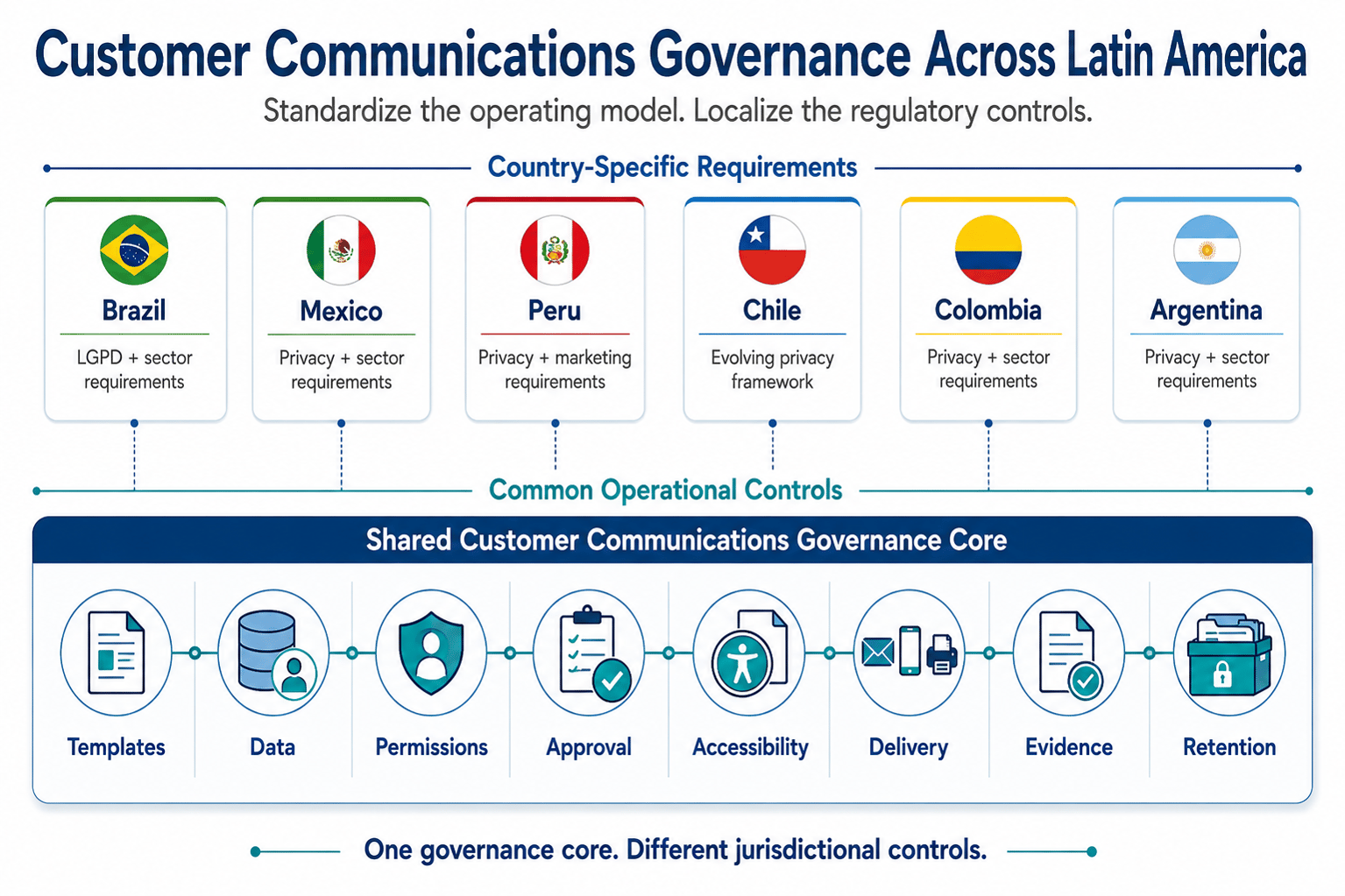
Latin American organizations should use a common governance core with country-specific control overlays rather than treating the region as one regulatory environment. Privacy, financial supervision, consumer protection, accessibility, retention, and communications requirements continue to develop independently across national jurisdictions.
The country overlay should sit above the shared controls. An enterprise can therefore keep one core process for versioning, approval, evidence, and security while applying different legal rules to Brazil, Mexico, Peru, Chile, Colombia, Argentina, and other markets.
Regulatory mapping table
The following matrix is a governance starting point rather than legal advice. Each organization should confirm the current rules for its sector, legal entity, communication type, and customer population before implementing controls.
|
Market |
Governance issue |
Communication control affected |
Primary authority to verify |
|
Brazil |
LGPD, data-subject rights, lawful processing, transparency, international transfers, enforcement |
Personalization, privacy notices, data-use rules, customer-rights workflows, audit evidence |
ANPD, LGPD text, applicable sector regulator |
|
Mexico |
Federal private-sector data protection framework enacted in 2025 |
Privacy notices, controlled processing, customer-rights procedures, use of personal data |
Diario Oficial de la Federación, Cámara de Diputados, sector regulator |
|
Peru |
New Personal Data Protection Law regulation effective in 2025 |
Consent, direct marketing, data governance, customer-right processes, security controls |
Peruvian ANPD, Ministry of Justice |
|
Chile |
Law 21.719 and transition toward its effective date |
Privacy governance, rights processes, transfers, accountability, future control updates |
Biblioteca del Congreso Nacional and future competent authority |
|
Colombia |
Law 1581 of 2012 and sector-specific rules |
Authorization, privacy notices, customer rights, data handling |
SIC and relevant sector regulator |
|
Argentina |
Law 25.326 and AAIP rules and guidance |
Data collection, consent, customer rights, databases, communications involving personal information |
AAIP and official legislation |
Brazil's LGPD regulates the processing of personal data by public and private entities and covers both physical and digital processing.
Mexico's current Federal Law on Protection of Personal Data Held by Private Parties was first published on March 20, 2025, replacing the previous 2010 law, and the Chamber of Deputies records a subsequent reform published on November 14, 2025.
Peru's new regulation under Law 29733 took effect on March 31, 2025 and includes clearer procedures concerning express consent for advertising and commercial-prospecting calls.
Chile's Law 21.719 was published in December 2024 and is scheduled to take effect on December 1, 2026, so organizations preparing communications governance in 2026 should distinguish transition work from obligations already in force.
Colombia's general personal data framework continues to be anchored in Law 1581 of 2012, which establishes general provisions for personal data protection.
Argentina's AAIP continues to identify Law 25.326 as the country's personal data protection framework while also maintaining guidance, registries, enforcement mechanisms, and materials related to modernization of the regime.
The governance implication is straightforward: do not hard-code one concept of "LATAM compliance" into every template. Maintain reusable common controls, then map jurisdiction-specific requirements to the content, data, approval, delivery, and evidence rules they affect.
How Does Accessibility Fit Into Communications Governance?
Accessibility should be controlled at the template and document-generation stage rather than treated as remediation after output has already been produced. A governance framework should define the applicable accessibility standards, ownership, validation process, release criteria, and exception process just as it does for privacy or regulated wording.
Scale alone makes accessibility difficult to dismiss as an edge case. In 2025, the European Commission reported that around 100 million people in the EU live with a disability. Although that figure concerns the EU rather than Latin America, it illustrates why multinational regulated organizations should treat accessible communications as a systematic design requirement rather than attempting to identify individual customers who may need an accessible version.
Two standards are especially important to distinguish:
- WCAG: The Web Content Accessibility Guidelines define testable accessibility requirements for web content. W3C's current WCAG overview recommends using WCAG 2.2 for new and updated accessibility efforts.
- PDF/UA: ISO 14289-2:2024 specifies how PDF 2.0 can be constructed as an accessible digital document using PDF technology.
Neither standard should automatically be described as a universal legal requirement for every organization in every LATAM jurisdiction. The correct governance process is to identify the applicable legal requirement first and then determine which technical standards support conformance.
The European Accessibility Act is also relevant to organizations that provide covered products or services in the EU. The Commission identifies areas including banking services, e-commerce, electronic communications, and transport services within the EAA framework.
An accessibility governance checklist should therefore include:
- Define which standards and laws apply to the communication.
- Use structured, accessibility-ready templates.
- Set the document language correctly.
- Preserve logical heading and reading order.
- Provide meaningful alternatives where non-text content requires them.
- Structure tables so assistive technologies can interpret them.
- Validate representative outputs before release.
- Re-test after material template or generation-engine changes.
- Record and remediate exceptions.
DocPath provides capabilities for producing accessible PDFs at scale and positions accessibility as part of its document-generation workflow. Organizations evaluating this area can also review our accessibility and inclusive PDF capabilities.
If accessibility, compliance, and document production currently operate as separate workflows, contact DocPath to discuss how accessible document generation can be incorporated earlier in the governed communications lifecycle.
What Should Be Automated, and What Still Requires Human Governance?
Automation is most valuable for repeatable controls such as selecting approved templates, applying personalization rules, enforcing permissions, generating documents, recording versions, routing approvals, distributing outputs, and logging events. Human judgment should remain responsible for interpreting regulatory change, approving material content, deciding policy, managing exceptions, and accepting residual risk.
A useful division of responsibilities looks like this:
|
Governance area |
Fragmented or manual approach |
Governed CCM approach |
Human decision still required |
Evidence generated |
|
Template changes |
Copies exchanged between teams |
Controlled template and version workflow |
Approve substantive wording |
Change history and approved version |
|
Regulatory wording |
Repeated manual edits |
Governed reusable content |
Interpret the requirement |
Approval and release record |
|
Personalization |
Ad hoc fields and scripts |
Rules linked to authorized data |
Define permissible use |
Rule and version history |
|
Approval |
Email chains |
Role-based workflow |
Legal or compliance approval |
Timestamped approval |
|
Delivery |
Separate tools by channel |
Centralized channel rules |
Define channel policy |
Delivery status |
|
Accessibility |
Remediation after output |
Accessible template and generation workflow |
Resolve exceptions |
Validation result |
|
Archive |
Scattered repositories |
Controlled archive process |
Determine retention |
Historical copy and metadata |
|
Audit response |
Manual reconstruction |
Linked communication history |
Interpret evidence |
Evidence package |
Our current platform combines centralized template and workflow management, omnichannel delivery, human validation, role-based controls, version tracking, traceability, monitoring, and document archiving.
It also integrates with ERP, CRM, insurance, core banking, SAP, JD Edwards, and IBM environments, which allows governance controls to sit around existing business systems rather than requiring every source system to become a customer-communications platform.
Automation should therefore enforce decisions wherever possible, but it should not silently make decisions that require legal or risk judgment. A workflow can prevent an unapproved template from being released. It cannot decide whether a newly enacted law applies to a particular product without accountable human interpretation.
What Customer Communications Governance Mistakes Create the Most Risk?
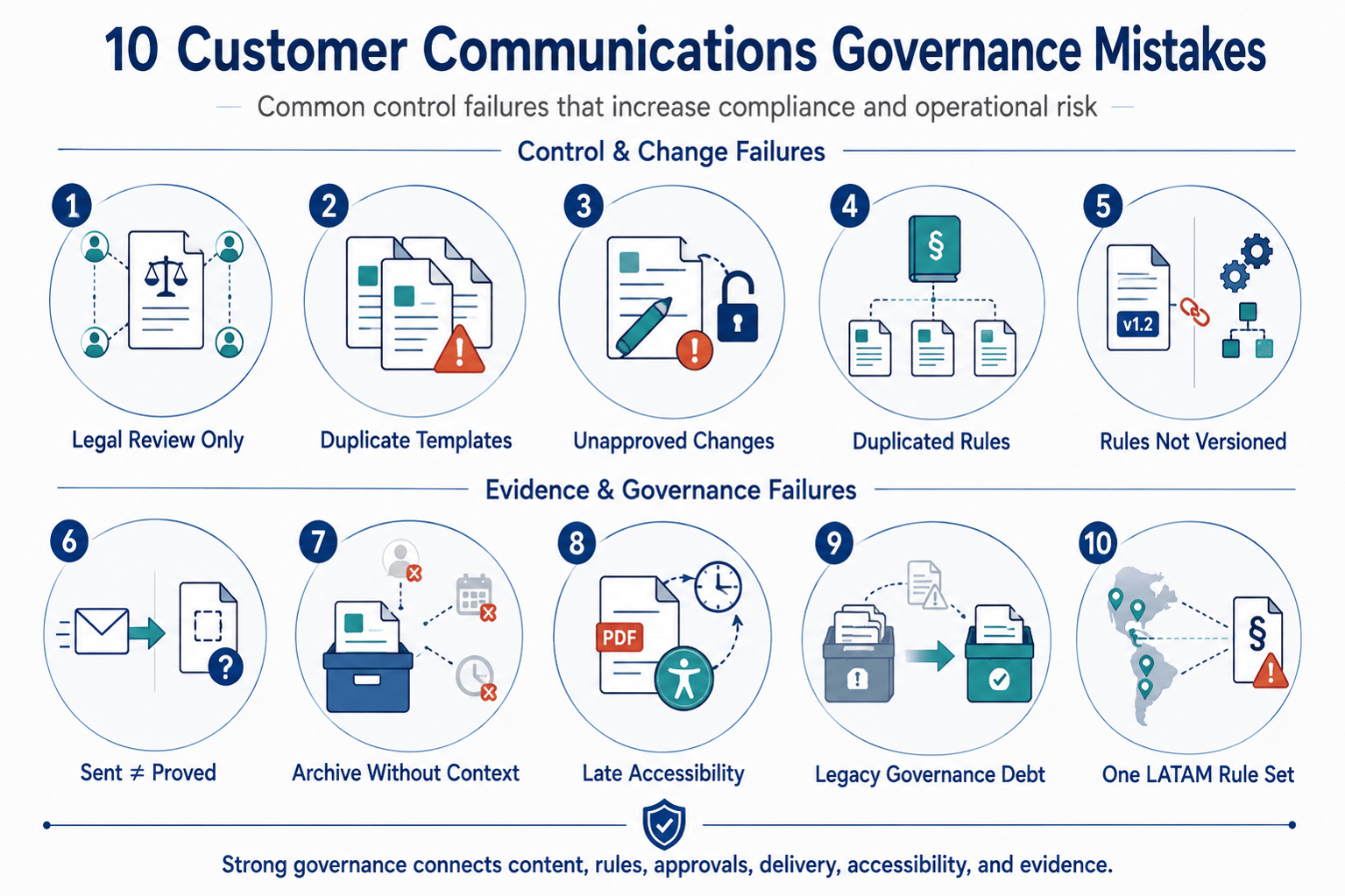
The most consequential governance failures usually come from uncontrolled change, fragmented ownership, inconsistent data use, missing evidence, and assumptions that a communication is compliant simply because it was technically delivered. These failures can remain hidden until a customer complaint, regulatory request, accessibility issue, dispute, or audit requires the organization to reconstruct what happened.
1. Treating governance as a legal review
Legal approval is one control, not the entire lifecycle. The correct wording can still be generated from the wrong template or sent with the wrong data.
Preventive control: Connect legal approval to versioning, generation, delivery, and evidence.
2. Allowing duplicate templates to proliferate
Duplicate templates make it difficult to determine which version is authoritative.
Preventive control: Maintain a controlled catalog with explicit active, superseded, and retired status.
3. Allowing regulated wording to be changed outside approval
Business users often need editing flexibility, but high-risk content should not become editable without appropriate control.
Preventive control: Separate editable content from protected regulatory components and route material changes through approval.
4. Duplicating jurisdictional rules throughout many templates
When the same rule is copied into multiple templates, every regulatory change becomes a search-and-replace project.
Preventive control: Centralize reusable jurisdiction-specific components where the document architecture allows it.
5. Versioning the document but not its rules
A PDF may be versioned while the personalization logic, data mapping, or delivery rule that created it changes separately.
Preventive control: Treat rules and relevant configuration as part of the governed communication definition.
6. Assuming "sent" means "proved"
A delivery status does not necessarily establish which content version was sent or why it was authorized.
Preventive control: Associate delivery evidence with the generated communication and its governing metadata.
7. Archiving output without enough context
Keeping a historical PDF is useful, but an investigation may require more than the image of the document.
Preventive control: Preserve the metadata necessary to reconstruct the communication according to applicable recordkeeping requirements.
DocPath has previously discussed the importance of modernizing both the transformation and archiving of customer communications so that historical outputs remain usable within modern document-management processes.
8. Testing accessibility only after generation
Late remediation creates repeated work when the same inaccessible template continues generating new documents.
Preventive control: Design accessibility into templates and validate during controlled testing.
9. Migrating legacy templates without reviewing governance debt
A technically successful migration can reproduce obsolete wording, duplicated forms, unclear ownership, and outdated business rules in the new environment.
Preventive control: Use migration as an opportunity to inventory, rationalize, classify, and reapprove high-risk content.
10. Treating Latin America as one regulatory jurisdiction
Brazil, Mexico, Peru, Chile, Colombia, Argentina, and other countries operate different legal and regulatory frameworks.
Preventive control: Maintain one common governance core with country and sector overlays.
How Do You Prove a Customer Communication Was Compliant?
A defensible communication record should allow an organization to reconstruct what was approved, which version was generated, which rules were applied, when and how the communication was delivered, and what evidence was retained. The final PDF alone may not contain enough information to answer all of those questions.
A practical communication evidence package can include:
- Communication or transaction ID.
- Customer or recipient reference.
- Template ID.
- Template version.
- Content or clause version where separately governed.
- Applicable jurisdiction and rule set.
- Approval record.
- Generation timestamp.
- Generated output.
- Delivery channel.
- Delivery status or proof where applicable.
- Accessibility validation result where required.
- Retention classification.
- Relevant audit and change history.
The useful test is reconstructability:
Could an authorized reviewer determine, using retained records, exactly what the customer received, which approved version produced it, why that version applied, and what happened during delivery?
This is a governance test rather than a universal statutory evidence standard. Exact records and retention periods should be mapped to the applicable sector and jurisdiction.
Argentina provides a simple example of why communication history can matter to privacy operations. The AAIP states that its inspections can examine data-processing activities, security measures, data-subject rights processes, transfers, service contracts, and communications to third parties involving personal data.
Brazil's enforcement activity also demonstrates that regulators can examine whether organizations have functional processes for interacting with data subjects rather than merely written policies.
A mature evidence model therefore links policy, execution, and recordkeeping. It allows an organization to demonstrate not merely what it intended its process to do, but what happened in the specific communication being reviewed.
How Should Governance Be Measured and Improved?
Customer communications governance should be measured through control effectiveness, not simply document volume. Useful metrics reveal whether the organization is using approved content, responding to change, controlling exceptions, producing accessible outputs, and retrieving evidence efficiently when needed.
Possible governance indicators include:
|
Metric |
What it reveals |
|
Communications with named owners |
Whether accountability is defined |
|
Communications mapped to current requirements |
Whether regulatory mapping is maintained |
|
Templates past scheduled review |
Potential governance debt |
|
Unauthorized change attempts |
Whether access controls are effective |
|
Approval-cycle time |
Whether governance creates avoidable bottlenecks |
|
Emergency-change turnaround |
Ability to respond to urgent updates |
|
Accessibility validation failures |
Quality of accessible document generation |
|
Delivery exceptions |
Reliability of communication execution |
|
Communications missing required evidence |
Auditability gaps |
|
Time to reconstruct a historical communication |
Practical audit readiness |
|
Duplicate or retired templates still in use |
Effectiveness of template lifecycle control |
|
Open exceptions by risk level |
Current governance exposure |
Do not assign a universal "good" percentage to these measures without context. A regulated bank sending millions of statements and a government agency managing citizen notices may require different tolerances, review intervals, and escalation thresholds.
A practical maturity model is:
- Fragmented: Different teams and systems manage communications independently.
- Documented: Policies, inventories, and ownership exist, but enforcement is largely manual.
- Controlled: Templates, roles, approvals, versions, and evidence are systematically governed.
- Automated: Repeatable controls are built into workflows and system rules.
- Measured and continuously improved: Exceptions and performance data actively shape governance changes.
Organizations can move through these stages incrementally. The priority should be the highest-risk communications first rather than attempting to redesign every customer touchpoint at once.
For insurers working across contracts, communications, and customer journeys simultaneously, our article on unifying CCM, CLM, and CXM into one governed document stack explores a related operating model.
How Can DocPath Support Governed Customer Communications?
DocPath provides the technology layer that can help organizations translate communications governance policies into controlled document workflows. The platform supports centralized template management, document generation, enterprise integration, multichannel delivery, human validation, access controls, versioning, traceability, accessibility, and archiving, while legal and compliance accountability remains with the organization.
At DocPath, our approach is built around the complete information and document lifecycle. Our current platform covers Customer Experience Management and Customer Communications Management, Contract Lifecycle Management, document generation, integration, delivery, and archival capabilities.
For governance programs, the relevant capabilities include:
- Centralized template management: Maintain controlled templates, content, workflows, and communication rules from a common environment.
- No-code document design: DocPath provides no-code template creation and editing capabilities intended to give authorized teams more direct control over document design.
- Human-in-the-loop validation: Sensitive communications can include review and approval steps instead of relying entirely on automated release.
- Permissions and governance: Role-based access control, data masking, controlled permissions, version control, and traceability support operational governance.
- Enterprise integration: DocPath connects with ERP, CRM, core banking, insurance, SAP, JD Edwards, and IBM environments so communications can use existing enterprise data and events.
- Omnichannel communication: The platform supports channels including print, email, SMS, web, WhatsApp, and mobile wallets.
- Accessible documents: DocPath provides tooling for scalable accessible PDF generation.
- Document lifecycle and archive: DocPath positions its offering around the lifecycle from document creation through signature and archiving.
We also hold ISO 9001, ISO 27001, and SOC 2 certifications and serves organizations across sectors including insurance, banking, financial services, logistics, manufacturing, and government.
The distinction remains important: technology can enforce the templates, workflows, permissions, rules, and evidence requirements that an organization configures, but it does not replace legal interpretation or organizational accountability.
If your organization is trying to centralize the creation, approval, generation, delivery, accessibility, and auditability of regulated customer communications, contact DocPath to discuss how a governed document and customer communications architecture could fit your existing systems.
Frequently Asked Questions
What is customer communications governance?
Customer communications governance is the set of policies, responsibilities, workflows, and technical controls used to determine how customer-facing communications are created, approved, personalized, delivered, retained, and evidenced. Its purpose is to make communication processes controlled and reconstructable rather than relying on individual teams to manage them independently.
Why do regulated industries need customer communications governance?
Regulated organizations often need to control customer data, wording, approvals, timing, accessibility, delivery, customer rights, and recordkeeping alongside the communication itself. Data protection authorities such as Brazil's ANPD actively supervise operational compliance, including how organizations communicate with data subjects.
What is the difference between CCM and communications governance?
Communications governance defines the policies, ownership, decisions, and controls that should apply. CCM provides technology for designing, generating, personalizing, and distributing customer communications and can automate many of those controls.
What records should be kept for regulated customer communications?
The required records depend on the jurisdiction, sector, communication, and applicable retention requirements. A practical governance model may preserve the approved template and version, customer or transaction reference, approval evidence, generation event, delivery information, and relevant audit history so the communication can later be reconstructed.
Does customer communications governance include accessibility?
Yes, accessibility should form part of the governance lifecycle wherever it is relevant to the communication or applicable requirements. PDF/UA-2 defines how PDF 2.0 can be constructed as an accessible digital document, while WCAG provides accessibility requirements for web content.
Are customer communications rules the same across Latin America?
No. Brazil, Mexico, Peru, Chile, Colombia, Argentina, and other LATAM jurisdictions maintain separate privacy and regulatory frameworks, and requirements can also differ by industry. A scalable enterprise model therefore uses common governance controls with jurisdiction-specific overlays.
Can CCM software guarantee regulatory compliance?
No. CCM software can help enforce configured templates, permissions, workflows, data rules, delivery processes, version controls, and evidence requirements, but the organization remains responsible for determining the obligations that apply and configuring its controls accordingly.