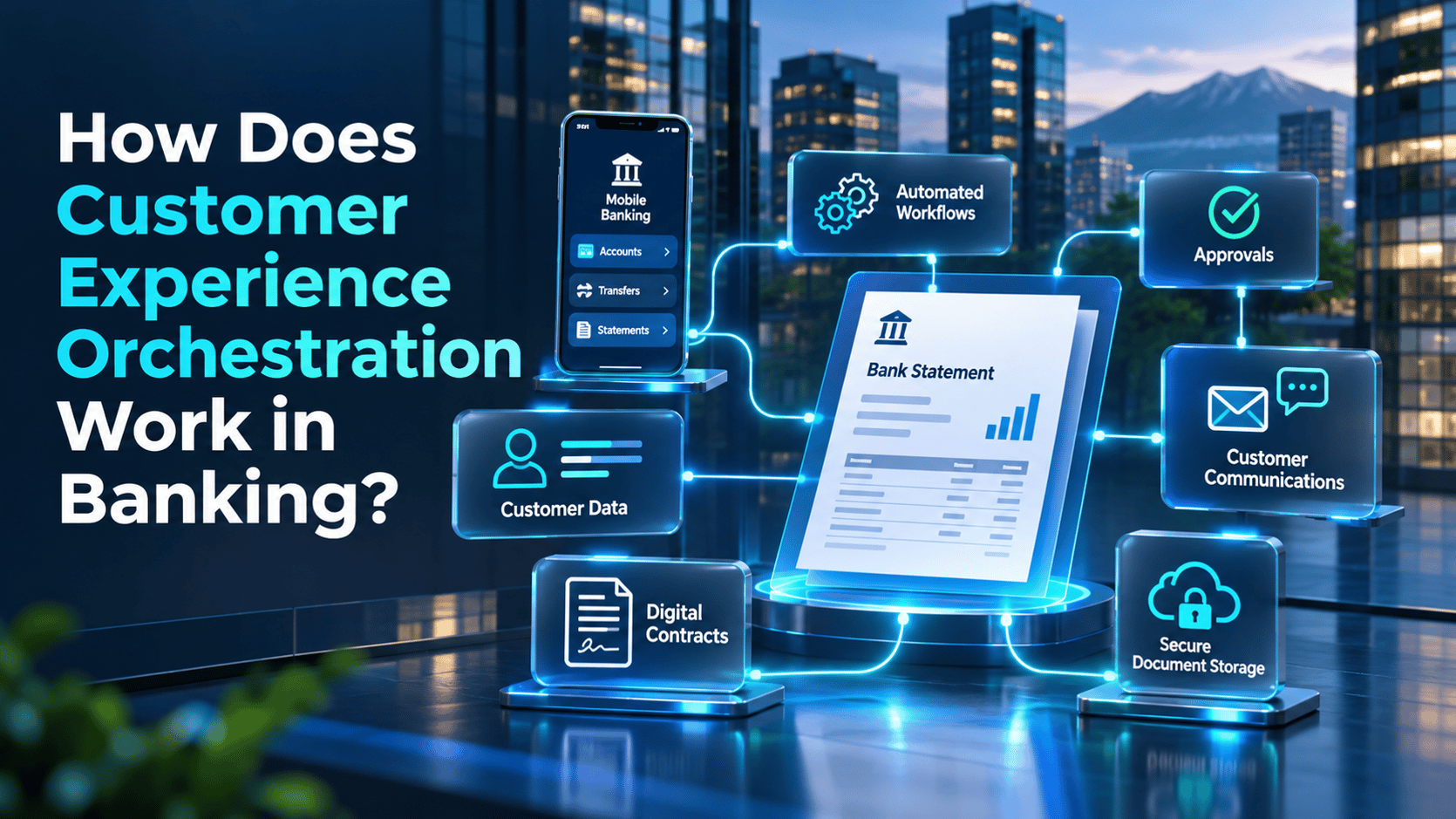
How Does Customer Experience Orchestration Work in Banking?
A customer completes a loan application through a mobile banking app, receives approval, and expects the next steps to be straightforward. Instead, the contract arrives late, the information differs from what appeared in the application, or the customer must contact support to find out what happens next.
This is the challenge that customer experience orchestration in financial services is designed to address: connecting customer interactions, decisions, operational processes, and communications into a consistent experience.
For banks and insurers across Latin America, the challenge is especially relevant as digital adoption advances alongside legacy technology constraints. Celent's 2025 Latin America banking research identifies faster digital service delivery, improved customer experiences, and legacy modernization among important regional priorities.
At DocPath, we believe successful orchestration must extend beyond digital touchpoints to include the documents, statements, notifications, and records that customers depend on.
In this guide, we explain how financial institutions can connect these processes, where customer journeys commonly break down, and how to build an implementation strategy around existing enterprise systems.
Quick Summary
Customer experience orchestration in financial services coordinates customer signals, decisions, workflows, and communications across channels and systems. It is valuable when journeys such as onboarding, lending, or insurance claims cross applications, branches, and back-office teams.
Effective implementation begins by mapping customer triggers, authoritative data sources, approval rules, required documents, delivery channels, and audit evidence. Orchestration can help reduce fragmented interactions, but it does not replace privacy, security, accessibility, or financial-services compliance controls.
The essential principles are:
- Connect the complete journey. Coordinate the customer-facing interaction with the operational processes needed to fulfill the request.
- Govern customer communications. Ensure statements, agreements, notices, and other documents reflect approved information and business rules.
- Verify the outcome. Measure successful completion, communication accuracy, delivery results, and exception handling rather than simply counting automated interactions.
DocPath's approach emphasizes connecting enterprise data with personalized, governed communications through its customer communications management capabilities.
What Is Customer Experience Orchestration in Financial Services?
Customer experience orchestration is the coordination of customer interactions, decisions, and workflows across multiple systems and channels to deliver a connected customer journey. In financial services, it brings together customer context, operational processes, business rules, and communications so that each interaction leads to an appropriate next action.
Consider a customer applying for a credit card. The journey may involve collecting personal information, verifying identity, evaluating eligibility, issuing a decision, producing an agreement, and delivering the final documentation.
These activities often involve different applications and teams. Orchestration provides a way to coordinate their sequence and respond appropriately when information changes or an exception occurs.
We recommend thinking about orchestration as five connected capabilities:
- Customer context: Understand the customer's current request, relevant history, and authorized information.
- Decision coordination: Apply approved business rules to determine the next action.
- Workflow execution: Trigger the appropriate process, application, or responsible team.
- Communication management: Produce and deliver the relevant customer-facing information.
- Outcome verification: Record the result and make the necessary information available for future interactions.
For financial institutions, communication management deserves particular attention. A banking decision is not necessarily a complete customer experience until the customer receives accurate, understandable information about its outcome.
What Makes Orchestration Different From Multichannel Communication?
Multichannel communication delivers information through multiple channels, while customer experience orchestration coordinates the actions, timing, and information that connect those channels. Omnichannel delivery can contribute to orchestration, but channel availability alone does not guarantee journey continuity.
For example, a customer might receive a payment confirmation by email, view the transaction in a mobile app, and contact a branch about the same payment.
A multichannel approach makes these touchpoints available. An orchestrated approach aims to ensure that each touchpoint uses the correct transaction status, that the necessary confirmation has been produced, and that a service representative can access the relevant context.
The distinction can be summarized as:
Customer event → Authorized decision → Operational action → Customer communication → Recorded outcome
At DocPath, we see the communication stage as an important connection between a financial institution's internal processes and what its customers actually experience.

Why Is Customer Experience Orchestration Important in Latin America?
Customer experience orchestration is particularly important in Latin America because banks must coordinate digital services across markets with different levels of financial access, technology adoption, and regulatory requirements. A successful regional strategy must support both digitally active customers and those who depend on alternative service channels.
According to the World Bank's Global Findex Database 2025, 69.72% of adults aged 15 and older in Latin America and the Caribbean, excluding high-income economies, owned a financial institution or mobile money account in 2024.
Mobile connectivity is another important consideration. GSMA's Mobile Economy Latin America 2025 report found that 64% of Latin America's population used mobile internet in 2024, representing approximately 413 million people.
These figures highlight the importance of coordinating increasingly digital customer journeys while preserving alternative ways for customers to receive information and assistance.
Financial access varies significantly between markets.
The World Bank's Global Findex Database 2025 provides a useful comparison of financial account ownership across Latin America. The following figures measure account ownership among adults aged 15 and older, including qualifying financial institutions and mobile money accounts.
|
Country
|
Account ownership in 2024
|
Implication for journey design
|
|
Brazil
|
86.38% of adults
|
Focus on connecting established financial relationships across products and channels
|
|
Chile
|
85.07% of adults
|
Prioritize coordinated servicing, document retrieval, and consistent communications
|
|
Colombia
|
57.06% of adults
|
Support flexible onboarding and customer assistance across channels
|
|
Mexico
|
53.03% of adults
|
Consider journeys that accommodate different levels of financial and digital engagement
|
These figures describe account ownership rather than customer satisfaction or orchestration maturity. The regional aggregate also excludes high-income economies, while the country comparison includes Chile.
Financial institutions should therefore avoid treating Latin America as one uniform customer market.
The technology investment environment reinforces this need for a selective approach. Celent's 2025 regional banking study reported average IT spending growth of 6.2% among Latin American banks in 2025, even as technology budget constraints and shortages of developer capacity remained barriers to innovation.
For us, the practical conclusion is clear: banks should prioritize connected customer journeys that can be improved through focused integration, reliable communications, and measurable outcomes.
Where Do Financial Customer Journeys Typically Break?
Financial customer journeys typically break when customer information, operational decisions, documents, and delivery processes are managed independently. Even when individual systems work correctly, the overall experience may fail because the information or action needed at the next stage is missing.
A customer might finish an account application successfully but receive an outdated agreement. Another might request an insurance document online, only to repeat the same information when contacting support.
We recommend examining five recurring sources of fragmentation.
1. Disconnected customer information
Banks may operate core financial systems, customer relationship management applications, archives, and service platforms that maintain different parts of the customer record.
When these systems cannot exchange the necessary context, employees and automated workflows may rely on incomplete or outdated information.
2. Repeated customer data collection
A customer supplies information during onboarding but must provide it again when completing a related application or requesting assistance.
We recommend identifying which information can be reused, under what authorization, and which system owns the authoritative record.
3. Document generation bottlenecks
Customer-facing documents may depend on manually maintained templates or separate production systems.
DocPath's published BBVA success story describes a previous environment in which template sharing by email, insufficient access controls, and limited change management created document-generation difficulties.
4. Inconsistent communications across channels
A mobile app may show one status while an email or customer service representative provides another.
A better approach is to coordinate communications around a shared business event and an authoritative status, while respecting channel preferences and delivery restrictions.
5. Limited operational traceability
Without consistent records, it may be difficult to determine which document version was produced, which rules were applied, or whether a delivery attempt succeeded.
These problems illustrate why improving the visible customer interface is not enough. The underlying information and communication processes must also work together.
How Does Customer Experience Orchestration Work End to End?
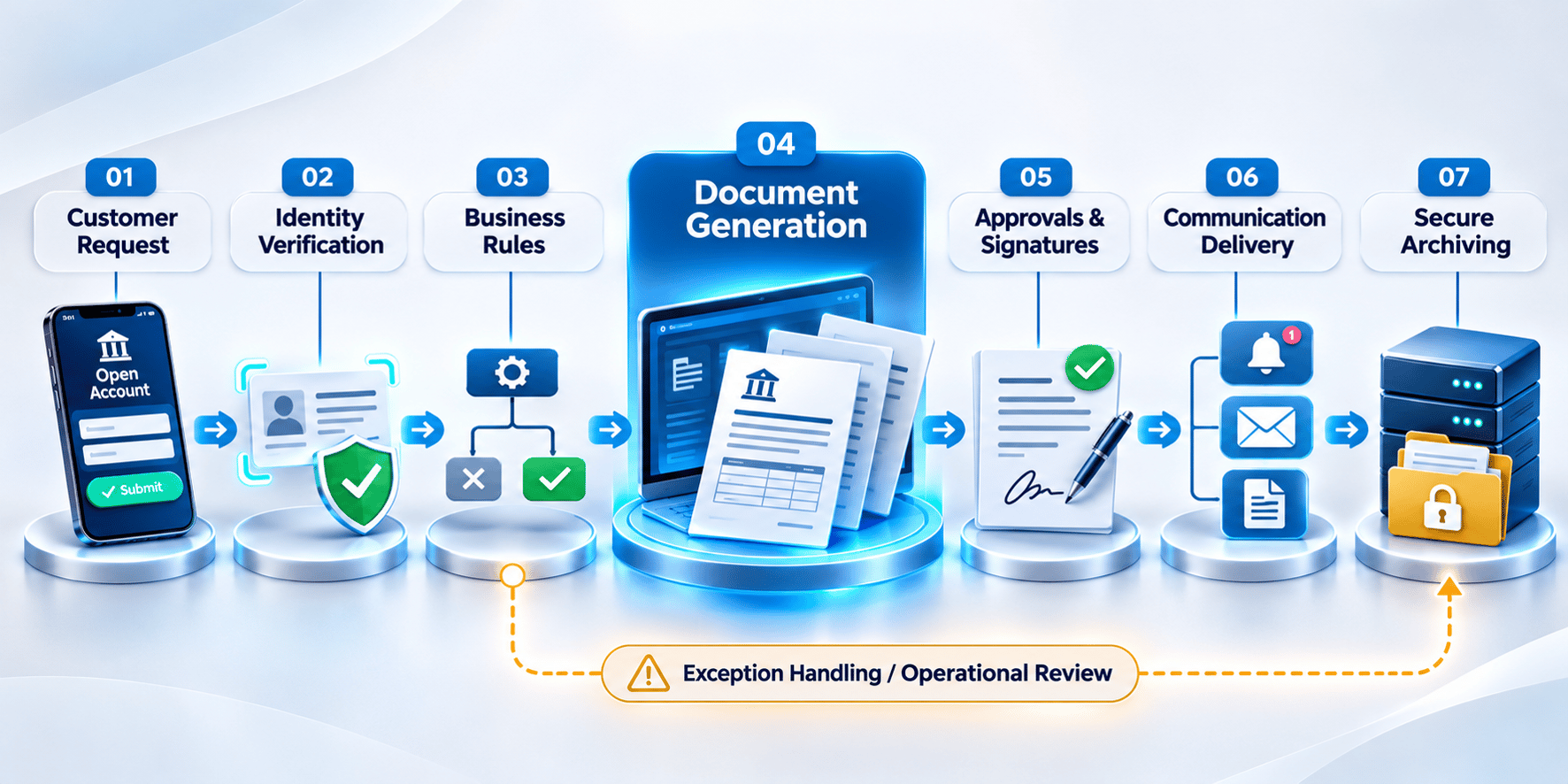
End-to-end customer experience orchestration connects a customer event to an authorized decision, the required operational actions, customer communications, and a verifiable outcome. The objective is to ensure that progress through a journey remains coordinated even when different systems or teams are responsible for individual stages.
Consider an illustrative digital bank account-opening journey.
The process begins when a customer submits an application, but it should not end when the bank approves the account. It must also account for mandatory disclosures, agreements, confirmations, delivery results, and relevant customer records.
A practical workflow would follow these stages:
- Capture the customer request. Collect the necessary application information using an appropriate digital form or assisted channel. Validate required fields and identify missing information before proceeding.
- Verify identity and eligibility. Route the relevant data to the bank's approved identity verification, screening, and eligibility systems. Handle failed checks or incomplete results through defined exceptions.
- Apply business rules. Use authorized banking systems to determine the application outcome and identify the next required actions.
- Generate the required documents. Populate approved templates with validated customer information, applicable terms, relevant disclosures, and appropriate language variants.
- Complete necessary approvals or signatures. Route agreements through approved approval and electronic signature services where required.
- Deliver the customer communications. Send the relevant documents and confirmations through permitted channels, then capture the available delivery status.
- Preserve the records. Retain documents, versions, metadata, and relevant process evidence according to the institution's policies and applicable requirements.
The same architecture must also account for exceptions. If verification fails, a signature is incomplete, or a delivery attempt does not succeed, the journey should route the case appropriately rather than silently marking it complete.
Where Does DocPath Fit in This Process?
DocPath supports the document and customer communications layer of an orchestrated financial journey. Our solutions help organizations connect customer data capture, personalized document generation, communication delivery, and document retrieval with existing enterprise processes.
We approach this through complementary capabilities:
- WelcomePath supports electronic forms, data capture, and personalized documents generated from captured and existing business information.
- EngagePath connects enterprise data with dynamic content to produce personalized customer communications and support multichannel delivery.
- HubPath supports document archiving, retrieval, and the use of document metadata within customer communication processes.
- DealPath supports contract requests, drafting, approvals, negotiation, and lifecycle management where those processes form part of the implementation.
The boundaries between these capabilities and other enterprise systems are important.
Core banking applications remain responsible for authoritative financial records and banking decisions. Identity verification, electronic signatures, and other specialist functions may involve separate approved services and integrations.
For example, the WelcomePath digital onboarding workflow connects with specialist identity verification and trust service providers rather than replacing those functions.
Our objective is to connect the information and communication processes that support the customer journey, not to suggest that every institution must replace its existing technology.
Connect customer journeys without unnecessarily rebuilding existing systems. Contact DocPath to discuss how your financial institution can coordinate data, documents, and customer communications.
How Does CX Orchestration Compare With CRM, CCM, and Workflow Automation?
Customer experience orchestration, customer relationship management (CRM), customer communications management (CCM), and workflow automation address different parts of the customer journey. Orchestration coordinates what happens across the journey, while supporting technologies manage customer information, execute processes, generate communications, and preserve records.
This distinction matters when banks assess existing investments or select additional capabilities.
|
Technology
|
Primary purpose
|
Banking example
|
Key limitation
|
|
Customer experience orchestration
|
Coordinates customer interactions and next actions across systems
|
Connecting application, approval, notification, and servicing activities
|
Requires reliable integrations and execution systems
|
|
CRM
|
Maintains customer relationship information and service context
|
Displaying customer profiles, interactions, and service cases
|
Does not inherently govern every official financial document
|
|
CCM
|
Creates, personalizes, generates, and delivers customer communications
|
Producing statements, disclosure letters, and confirmations
|
Does not independently replace all customer journey decisioning
|
|
Workflow automation / BPM
|
Executes defined operational processes and approvals
|
Routing a credit application for review
|
May not manage customer-facing content and channel delivery
|
|
Customer journey mapping
|
Describes interactions and identifies friction
|
Identifying delays in digital account opening
|
Maps a journey rather than executing it
|
|
Document management / ECM
|
Stores, organizes, retrieves, and governs documents
|
Retrieving archived agreements and statements
|
Does not necessarily determine the next customer action
|
These capabilities are complementary rather than interchangeable.
For example, a CRM can provide customer relationship context, a workflow engine can route an application, and a CCM solution can generate the appropriate customer communication. An orchestration design connects these activities around a common customer outcome.
DocPath's EngagePath focuses on the CCM component, including dynamic content, document generation, personalization, and distribution across supported formats and channels.
That is why we consider communication execution a central part of financial customer experience design. Coordinating an action is valuable, but delivering the correct, understandable, and governed communication is often what makes the action meaningful to the customer.
Which Banking and Insurance Journeys Benefit Most From Orchestration?
Financial customer journeys benefit most from orchestration when they involve multiple systems, approvals, customer communications, and operational handoffs. Digital onboarding, account servicing, credit management, insurance policy administration, and document requests are particularly useful starting points.
We recommend prioritizing journeys where communication problems directly affect the customer's ability to complete a financial task.
|
Customer journey
|
Common challenge
|
Communication requirements
|
Potential DocPath contribution
|
|
Digital bank onboarding
|
Repeated information requests and disconnected application stages
|
Welcome documents, agreements, disclosures, and confirmations
|
Electronic forms and personalized document generation
|
|
Credit card servicing
|
Customer information and transaction data maintained across separate systems
|
Statements, transaction notices, and account communications
|
Dynamic content and personalized statement generation
|
|
Insurance policy management
|
Multiple departments maintain policy and customer information
|
Policy documents, renewal notices, and amendments
|
Governed templates and communication workflows
|
|
Customer document requests
|
Difficulty retrieving the correct document or agreement
|
Statements, contract copies, and policy records
|
Document search, retrieval, and controlled distribution
|
These examples represent potential applications, not guaranteed outcomes from implementing any particular technology.
Two published DocPath customer cases illustrate why communication and document processes deserve a place in a broader orchestration strategy.
Chubb: Coordinating Insurance Communications Across Latin America
In the Chubb customer success story, available in 2026, DocPath reports a 15-year CCM relationship spanning nine Latin American countries. The deployment supports the creation and management of documents across Chubb's insurance product portfolio.
The case describes how modular document design allows departments such as Marketing to collaborate on content without placing all layout responsibilities within operational applications. The reported benefits include reduced duplicated work and improved support for documents viewed on mobile devices.
The broader lesson is that document production can become a shared, governed capability rather than a separate responsibility for each application or department.
BBVA: Modernizing Document Governance Without Rebuilding Banking Applications
BBVA needed to replace an existing document generation environment while supporting its branches and maintaining compatibility with established applications.
The published BBVA implementation describes the automatic conversion of existing forms, centralization within an internal cloud, and the introduction of a shared repository for managing template versions.
The case also reports improved template governance and reduced maintenance requirements. It does not establish that BBVA deployed a complete customer journey orchestration platform.
Together, these examples demonstrate how better document management and customer communications can support the operational foundations needed for connected financial experiences.

How Can Financial Institutions Implement CX Orchestration Step by Step?
Financial institutions should implement customer experience orchestration around a clearly defined customer outcome, beginning with one manageable journey. A phased approach helps teams identify integration requirements, validate communication controls, measure results, and resolve operational problems before expanding.
At DocPath, we recommend a seven-step implementation framework.
Step 1: Select a Journey With a Measurable Outcome
Start with a process such as digital onboarding, statement requests, or insurance policy renewals.
Define what successful completion means from the customer's perspective. For onboarding, this might include receiving an application decision, completing required agreements, and obtaining confirmation that the account is ready to use.
Establish baseline measurements before changing the process.
Step 2: Map Every Trigger and Operational Handoff
Document the journey from the initial customer request to its final outcome.
Identify the systems, departments, decisions, and communications involved. Record where customers wait, repeat information, or experience inconsistent responses.
The deliverable should be a current-state journey map with clearly assigned responsibilities.
Step 3: Identify Authoritative Data Sources
Determine which system owns each essential data element, including customer identity, account status, transaction details, product terms, and communication preferences.
Avoid creating competing records when the necessary information already exists in an authorized source.
Data ownership should be documented before teams design personalized communications.
Step 4: Define Business Rules and Compliance Controls
Identify the approvals, eligibility checks, privacy requirements, and communication restrictions that govern each stage.
For multi-country operations, establish which requirements are shared and which need jurisdiction-specific rules.
Include exception handling for incomplete data, failed verification, rejected decisions, and unsuccessful communications.
Step 5: Design the Required Customer Communications
List every document or notification needed to complete the selected journey.
For each communication, define:
- The triggering event and responsible system.
- The approved template and content owner.
- Required data fields and applicable business rules.
- Language and accessibility requirements.
- Authorized delivery channels and preferences.
- Version history, retention, and evidence requirements.
This is where a dedicated CCM capability can become especially valuable.
Step 6: Integrate Systems and Test the Complete Journey
Connect the necessary applications through supported interfaces and verify data handling, workflow execution, and document generation.
DocPath supports integration approaches involving APIs, enterprise applications such as SAP and JD Edwards, and legacy IBM mainframe environments. Exact compatibility and implementation requirements should be confirmed for the institution's environment.
Testing should cover normal transactions and failure scenarios.
Step 7: Pilot, Measure, and Improve
Launch the new process with a controlled group or appropriately limited workload.
Compare results with the baseline, investigate exceptions, and document whether the implementation meets its acceptance criteria.
Expand only when the organization can demonstrate that the process works reliably under the relevant operating conditions.
What Should a CX Orchestration Pilot Prove Before Expansion?
A CX orchestration pilot should prove that the intended customer outcome can be completed accurately, securely, consistently, and accessibly. It should also demonstrate that operational teams can identify errors, manage exceptions, and retrieve relevant evidence.
We recommend evaluating the pilot against the following acceptance checklist:
- Outcome completion: Can customers finish the intended journey without unnecessary manual intervention?
- Data accuracy: Do communications use the correct authoritative information?
- Document governance: Are approved templates and content versions applied consistently?
- Delivery verification: Can the institution distinguish successful delivery from attempted or failed delivery?
- Accessibility: Do the generated documents pass the defined accessibility checks?
- Exception handling: Are incomplete and unsuccessful transactions routed appropriately?
- Operational traceability: Can authorized personnel reconstruct important decisions, communications, and outcomes?
Each requirement should have an owner, a test method, and documented acceptance criteria.
The goal is not to automate the highest possible number of interactions. It is to make a selected customer journey dependable enough to expand responsibly.
How Can Banks Personalize Communications Without Losing Control?
Banks can personalize customer communications by combining authorized customer data with approved templates, business rules, and controlled delivery processes. Effective personalization makes information more relevant without changing mandatory disclosures or weakening the governance needed for regulated communications.
Personalization should not mean generating unrestricted content for every customer.
A bank might personalize a monthly credit card statement by highlighting relevant transaction categories, using the customer's preferred language, or presenting account-specific information within an approved layout.
At the same time, the statement must preserve the correct financial figures, required disclosures, and applicable contractual information.
We recommend organizing personalization around four controls:
- Approved content: Maintain centrally governed templates and reusable content components.
- Trusted information: Populate documents from authorized, validated data sources.
- Defined rules: Specify which elements can vary and which must remain unchanged.
- Traceable execution: Record relevant versions, generation events, and delivery outcomes.
DocPath's EngagePath solution is designed around connecting enterprise information with dynamic, personalized customer communications, including a banking use case involving credit card statements.
The principle is straightforward: personalize what improves the customer's understanding while protecting the accuracy of information that must remain controlled.
What Role Should AI Play in Customer Experience Orchestration?
AI can support financial customer experience orchestration by helping interpret requests, retrieve relevant information, summarize records, and recommend authorized next actions. However, AI-assisted interactions should operate within defined permissions, approved business processes, and appropriate verification requirements.
At DocPath, our Path to AI approach distinguishes between a deterministic foundation for approved information, content, and business rules and an additional AI layer that operates with relevant context and traceability.
For example, an AI assistant might help a customer understand an insurance document. The authoritative policy terms should still come from the approved document and relevant systems rather than an unverified generated response.
We recommend human escalation when an AI-assisted process encounters uncertainty, a sensitive decision, or an action outside its approved authority.
AI should help customers navigate financial information without becoming an uncontrolled source of financial commitments.
Make personalized communications part of your customer experience strategy. Contact DocPath to explore how your organization can connect customer information, documents, and communication workflows.
How Do Accessibility, Privacy, and Local Regulations Affect Orchestration?
Accessibility, privacy, security, and regulatory requirements must be considered throughout financial customer experience orchestration. Because Latin American jurisdictions have different legal frameworks, financial institutions should configure and review the applicable controls for each country rather than assuming one regional workflow satisfies every obligation.
The implications extend beyond storing customer information securely. Institutions should also consider what information appears in a document, how it is delivered, who can access it, and how the process can be verified.
For regional implementations, four legal frameworks deserve particular attention.
|
Country
|
Relevant data protection framework
|
Considerations for customer communications
|
|
Brazil
|
Lei Geral de Proteção de Dados Pessoais (LGPD), Law 13.709/2018
|
Lawful processing, data subject rights, appropriate access, and privacy safeguards
|
|
Mexico
|
Federal Law on Protection of Personal Data Held by Private Parties, published in March 2025
|
Privacy notices, lawful processing, personal data handling, and applicable data subject rights
|
|
Colombia
|
Law 1581 of 2012
|
Data processing principles, authorization requirements where applicable, customer rights, and security responsibilities
|
|
Chile
|
Law 19.628 and the forthcoming changes under Law 21.719
|
Existing privacy obligations, transition planning, and preparation for updated data protection requirements
|
Chile's Law 21.719 is scheduled to take effect on December 1, 2026, making the distinction between current and forthcoming requirements particularly important for organizations preparing implementations in November 2026.
These laws are starting points, not comprehensive checklists for financial-services compliance. Banks and insurers must also assess applicable sector-specific requirements, contractual obligations, retention rules, and cross-border processing arrangements.
We recommend incorporating legal and compliance review into template design, data access policies, delivery-channel configuration, and records management.
For a more detailed regional perspective, our guide to compliant customer communications for Latin American banks explores the relationship between document workflows and country-specific requirements.
Why Should Accessible PDFs Be Part of Banking CX Orchestration?
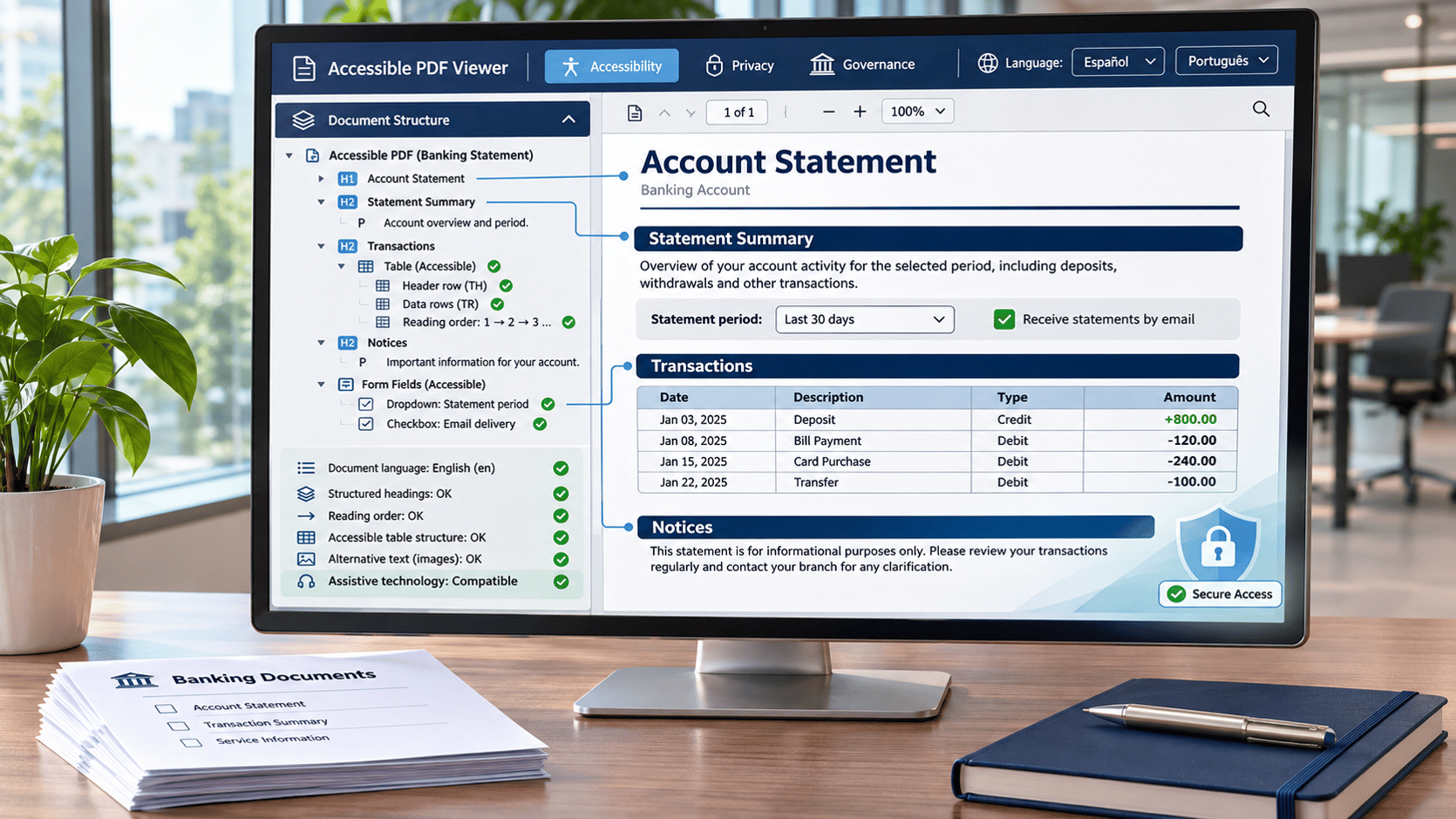
Accessible PDFs help customers using assistive technologies navigate and understand important financial information. Accessibility should therefore be addressed during document design, generation, delivery, and testing rather than treated as a final formatting adjustment.
Financial documents may contain complex tables, contractual conditions, account details, and instructions requiring careful presentation.
The World Wide Web Consortium's WCAG 2.2 guidance provides accessibility requirements for digital content, while ISO 14289-2:2024 defines requirements for constructing accessible PDF documents using PDF 2.0 technology.
We recommend including these checks in financial document quality assurance:
- Semantic structure: Use meaningful headings, paragraphs, lists, and tables.
- Reading order: Ensure information follows a logical sequence for assistive technologies.
- Text alternatives: Provide appropriate descriptions for meaningful non-text content.
- Language and forms: Identify document language and provide accessible form fields where applicable.
- Practical testing: Combine automated accessibility checks with appropriate manual and assistive technology testing.
DocPath's accessibility and inclusion capabilities focus on helping organizations produce more accessible PDF documents as part of their communication processes.
Accessibility also needs to be considered alongside language localization. A document may be technically accessible but still difficult to understand if its terminology, instructions, or presentation do not suit the intended customer.
WCAG, PDF/UA, and local legal requirements are related but distinct. Meeting a technical standard does not, by itself, establish compliance with every applicable law.
Which KPIs Measure Customer Experience Orchestration Success?
Customer experience orchestration success should be measured through completed journeys, communication accuracy, operational efficiency, and verifiable outcomes. Banks should evaluate whether customers accomplish their intended tasks, not simply how many messages or automated events a system processes.
For example, sending an onboarding confirmation does not necessarily mean the customer has successfully completed onboarding.
A useful measurement framework should distinguish customer outcomes from supporting operational activity.
|
KPI
|
Measurement formula
|
What it reveals
|
|
Journey completion rate
|
Successfully completed journeys ÷ eligible journeys started × 100
|
Whether customers complete the intended process
|
|
Communication error rate
|
Incorrect communications ÷ communications reviewed × 100
|
Quality of generated customer information
|
|
Verified delivery rate
|
Confirmed deliveries ÷ delivery attempts × 100
|
Effectiveness of communication distribution
|
|
Repeat-contact rate
|
Cases with related repeat contact ÷ eligible completed cases × 100
|
Whether customers require additional assistance
|
|
Document processing time
|
Completion timestamp minus authorized request timestamp
|
Speed of document-related operations
|
|
Accessibility pass rate
|
Documents passing defined accessibility tests ÷ documents tested × 100
|
Performance against documented accessibility criteria
|
These are proposed operational definitions, not universal industry benchmarks.
Institutions should establish consistent denominators, observation periods, customer cohorts, and exception rules before comparing performance.
Delivery metrics also require careful interpretation. A delivery confirmation does not necessarily establish that the customer opened, read, or understood the information.
We recommend evaluating journey completion alongside communication quality and exception resolution. A faster process that generates inaccurate statements is not an improvement.
A useful scorecard should also identify which team owns each measure and what corrective action follows an unacceptable result.
How Should Banks Estimate the ROI of CX Orchestration?
The return on investment for customer experience orchestration should be calculated by comparing the verified costs and outcomes of an existing journey with its performance after implementation. The business case should include implementation expenses, ongoing operating costs, and benefits that can reasonably be attributed to the change.
Rather than relying on generic savings estimates, we recommend building a journey-specific ROI model.
Include these cost categories:
- Software licensing and ongoing subscriptions.
- Integration, migration, and implementation work.
- Internal development, maintenance, and support.
- Document generation, printing, and distribution.
- Manual processing, rework, and exception handling.
- Security, accessibility, compliance, and governance activities.
Then measure validated benefits using comparable transaction volumes and periods.
A simple financial model is:
ROI (%) = [(Validated financial benefits − Total implementation and operating costs) ÷ Total implementation and operating costs] × 100
For example, a bank could compare the labor and distribution costs of its previous onboarding process with those measured during a controlled pilot.
Any benefits from improved retention or additional sales should be calculated separately unless the institution has credible evidence connecting those outcomes to the orchestration initiative.
DocPath publishes SaaS pricing and plan information for its solutions, including enterprise configurations that require custom pricing based on solution design. Financial institutions should verify the applicable commercial scope, regional terms, and integration requirements before using vendor prices in an investment model.
The strongest business case is one that operations, finance, technology, and compliance teams can all validate.
Build More Connected Financial Customer Experiences With DocPath
Customer experience orchestration is not simply about making banking interactions faster. It is about ensuring that customer information, operational decisions, required documents, and communications work together to produce dependable outcomes.
For financial institutions across Latin America, we believe this starts with connecting existing enterprise systems to governed, personalized, and accessible customer communications.
At DocPath, we help organizations strengthen that communication and document execution layer so customer journeys can operate with greater consistency, traceability, and control.
Contact DocPath to discuss your customer experience orchestration requirements and explore how our solutions can support your financial institution's existing technology environment.
What Common Mistakes Should Financial Institutions Avoid?
Customer experience orchestration initiatives can underperform when organizations automate individual interactions without addressing the information, controls, and operational dependencies connecting them. Avoiding these mistakes requires a clear customer outcome, reliable data ownership, governed communications, and measurable implementation criteria.
We recommend reviewing seven common pitfalls before expanding an orchestration program.
1. Automating channels without coordinating the journey
A bank may improve its mobile application and email notifications while leaving the underlying servicing process unchanged.
How to avoid it: Map the complete journey and define the intended outcome before automating individual touchpoints.
2. Using inconsistent customer information
Different systems may hold different versions of customer details or transaction status.
How to avoid it: Assign ownership to authoritative data sources and validate information before initiating downstream actions.
3. Overlooking official documents
An application can appear complete even though the customer has not received the necessary agreement or confirmation.
How to avoid it: Include document generation, delivery, and retention requirements in the original journey design.
4. Personalizing without sufficient governance
Dynamic content can introduce errors when it draws from incorrect data or bypasses approved wording.
How to avoid it: Use controlled templates, explicit business rules, and documented approval responsibilities.
5. Treating accessibility as optional
Document accessibility problems can remain unnoticed when testing focuses only on visual appearance.
How to avoid it: Include relevant accessibility criteria and representative testing in document quality assurance.
6. Giving AI systems excessive authority
An AI-assisted workflow may create unnecessary risk when it initiates sensitive actions without appropriate permissions or verification.
How to avoid it: Establish authorized functions, dependable source information, monitoring, and human escalation.
7. Measuring activity instead of outcomes
A bank might report increased message volumes or reduced processing time without assessing whether the customer's actual problem was resolved.
How to avoid it: Combine completion rates, communication accuracy, exception handling, and customer service measurements.
The common theme is that orchestration depends on the quality of the processes it connects.
We believe financial institutions should address these foundations before pursuing more complex automation. Doing so creates a clearer path toward sustainable improvements without relying on technology alone to correct organizational problems.
Frequently Asked Questions About CX Orchestration
Customer experience orchestration combines journey coordination with the systems required to execute customer-facing outcomes. The right implementation depends on a financial institution's existing architecture, business priorities, regulatory environment, and operational requirements.
The following questions address common considerations for banks and insurers evaluating orchestration.
What Is Customer Experience Orchestration in Financial Services?
Customer experience orchestration is the coordination of customer data, interactions, decisions, and operational processes across financial service channels. Its purpose is to help customers progress through connected journeys, including the delivery of required information and documents.
An effective approach also accounts for approvals, exception handling, security, and verification of the final customer outcome.
Is Customer Experience Orchestration the Same as Customer Communications Management?
No. Customer experience orchestration coordinates interactions and next actions across a journey, while customer communications management focuses on creating, personalizing, generating, and delivering customer-facing information.
CCM is a complementary capability that supports communication execution, particularly when banking or insurance journeys require personalized statements, agreements, notices, or other governed documents.
Can Banks Implement CX Orchestration Without Replacing Their Core Banking Systems?
In many cases, banks can coordinate selected customer journeys through integrations with existing applications rather than replacing their core banking platforms. Feasibility depends on available interfaces, data quality, security controls, and the operational requirements of the selected process.
DocPath's BBVA document modernization case illustrates how an existing document generation environment was modernized without requiring modifications to the bank's calling applications.
Which Customer Journey Should a Financial Institution Orchestrate First?
A financial institution should begin with a journey that has identifiable friction, clear process ownership, accessible data, and a measurable completion outcome.
Digital onboarding, authenticated document requests, account confirmations, and routine servicing processes may be suitable starting points. The final choice should reflect customer impact, implementation complexity, and risk.
How Much Does Customer Experience Orchestration Cost?
Customer experience orchestration costs depend on workflow complexity, the number of connected systems, communication volumes, security requirements, and the scope of implementation.
Institutions should evaluate licensing, integration, document production, operational maintenance, and governance costs together. A journey-specific total cost of ownership is more useful than a generic estimate that does not reflect the organization's technology environment.
How Can Banks Make Orchestrated Financial Documents Accessible?
Banks can improve document accessibility by using appropriate document structures, logical reading order, meaningful text alternatives, clearly identified languages, and accessible forms where required.
Documents should be evaluated against relevant accessibility standards and tested with appropriate assistive technologies. The W3C's accessibility guidelines and ISO's PDF/UA framework provide recognized technical references, although applicable legal obligations must also be assessed separately.