
Discover how to modernize insurance contract management with the best CLM platform, integrating legacy systems and reducing operational risks.
Discover why generic CLM solutions fall short for insurers and explore the challenges of managing contracts in the insurance industry.
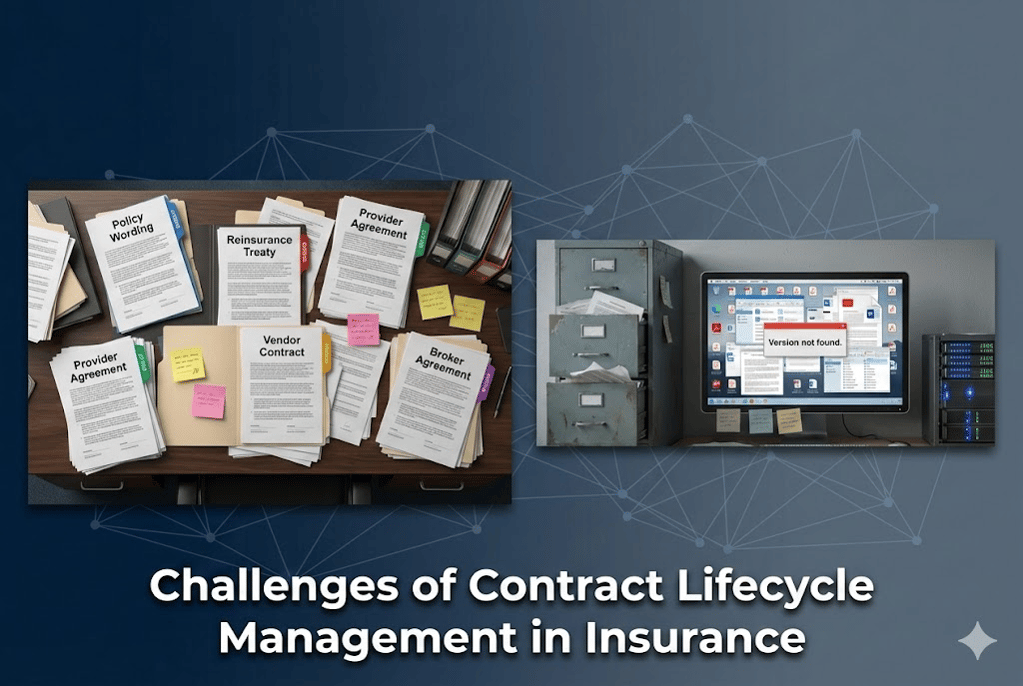
Most insurers have already invested in “something” for contract management. There are policy admin systems, reinsurance tools, shared drives full of Word files, maybe even a generic CLM rollout that promised a lot and delivered much less. Yet day to day, contract lifecycle management still feels chaotic across policy wordings, provider agreements, reinsurance treaties and vendor contracts.
If you search for help, you mostly find generic CLM content that talks about scattered contracts, slow approvals and lack of visibility. Those issues are real, but they barely scratch the surface of insurance specific complexity. They rarely discuss the reality of managing thousands of consumer policies, a smaller set of high value reinsurance deals, and highly negotiated provider or broker agreements under multiple regulators.
This article takes a different angle. It looks at the structural, operational and governance challenges that are specific to CLM in insurance, so CIOs, legal, compliance and operations leaders can frame a realistic modernization agenda. DocPath’s own work on CLM for insurers emphasizes that you need to start from your contract landscape and legacy reality, not from a generic CLM feature list. (global.docpath.com)
We will not go into solution detail here. Instead, we will help you name the problems clearly so that any later CLM initiative has a fighting chance of success.
What makes contract lifecycle management in insurance uniquely difficult?
At its simplest, contract lifecycle management in insurance is the end to end control of every contract the insurer issues or signs, from drafting and negotiation through approval, execution, storage, monitoring, renewal and termination. In an insurance context, that includes policy documents, endorsements, reinsurance treaties, broker and distributor agreements, and vendor contracts.
The challenge is that these contract families are very different from one another.
- Policy contracts and endorsements are high volume and often standardized, but still need to reflect product and regulatory nuances for each line and market.
- Provider and network agreements in health or medical lines embed fee schedules, SLAs and quality metrics that need to tie directly to claims and provider performance data. (flowforma.com)
- Reinsurance treaties and facultative contracts are lower volume but high value, with bespoke terms and complex risk sharing. (swissre.com)
- Distribution agreements with agents, brokers, MGAs and bancassurance partners must respect local licensing and distribution rules. (KPMG Assets)
- Operational and vendor contracts for IT, outsourcing, TPAs and loss adjusters carry data protection, cyber security and outsourcing obligations. (Pinsent Masons)
Each contract family has different owners, different data that matters, and different regulatory constraints. Policy wording changes sit with product and underwriting. Provider contracts are often driven by network management or health operations. Reinsurance is usually handled by a specialist team. Vendor and TPA contracts may be owned by procurement.
McKinsey has pointed out that business complexity in insurance – product variants, channels, brands and local adaptations – is a major driver of operating cost and makes standardization hard. (McKinsey & Company)
That same complexity makes CLM uniquely hard in insurance. A generic CLM model that assumes a single contract type and one “contract owner” rarely matches this reality. This is where the problems start.
How do fragmented repositories and legacy systems block insurance CLM?
If you map where contracts actually live in a typical insurer, the picture is rarely pretty.
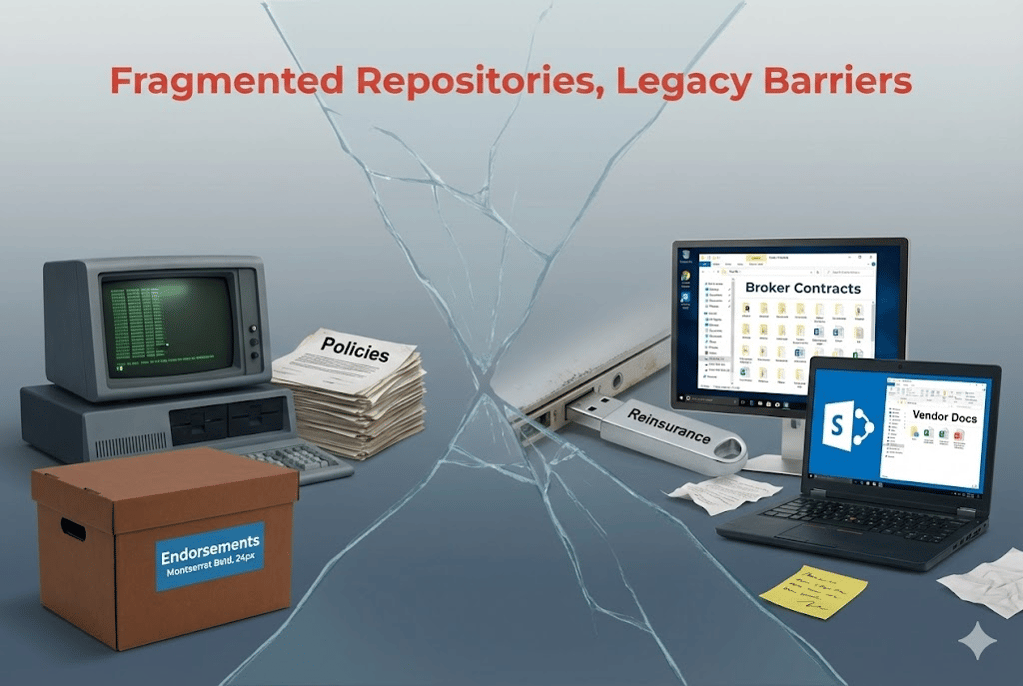
Policies and endorsements are often generated by core systems on mainframe or AS/400 platforms using legacy composition engines. Reinsurance treaties may live as Word or PDF documents on shared drives. Broker and agency contracts are versioned via email and stored by distribution teams on local servers. Vendor and TPA contracts might sit partly in a procurement system, partly on SharePoint and partly in someone’s inbox.
On top of that, many insurers have grown by acquisition, so each acquired book brings its own templates, tools and storage habits. DocPath’s own CLM guide talks about contract landscapes that evolved over decades through mergers, local point solutions and hard coded print engines. (global.docpath.com)
Generic CLM articles often describe fragmented repositories and lack of visibility as a general issue. (Ivalua) In insurance this fragmentation is more structural.
The consequences are predictable:
- There is no single, reliable source of truth for contracts. Teams cannot easily tell which version of a wording or endorsement is final, or which treaty applies to a particular risk.
- It becomes very hard to answer basic questions such as “how many contracts contain this specific exclusion clause” or “which counterparties carry a certain termination right”.
- Audits and regulatory examinations turn into manual work programs because approvals, clauses and obligations are scattered across systems.
Healthcare contract management content from sectors with similar complexity notes that contracts spread across inboxes, drives and outdated CLM tools cause delays, confusion and compliance risk. (flowforma.com)
Insurers face the same issue, but scaled up across multiple lines, regions and decades of legacy systems. Any CLM initiative that pretends this landscape can be “cleaned up” quickly is likely to stall.
Why do regulation and compliance across jurisdictions complicate CLM?
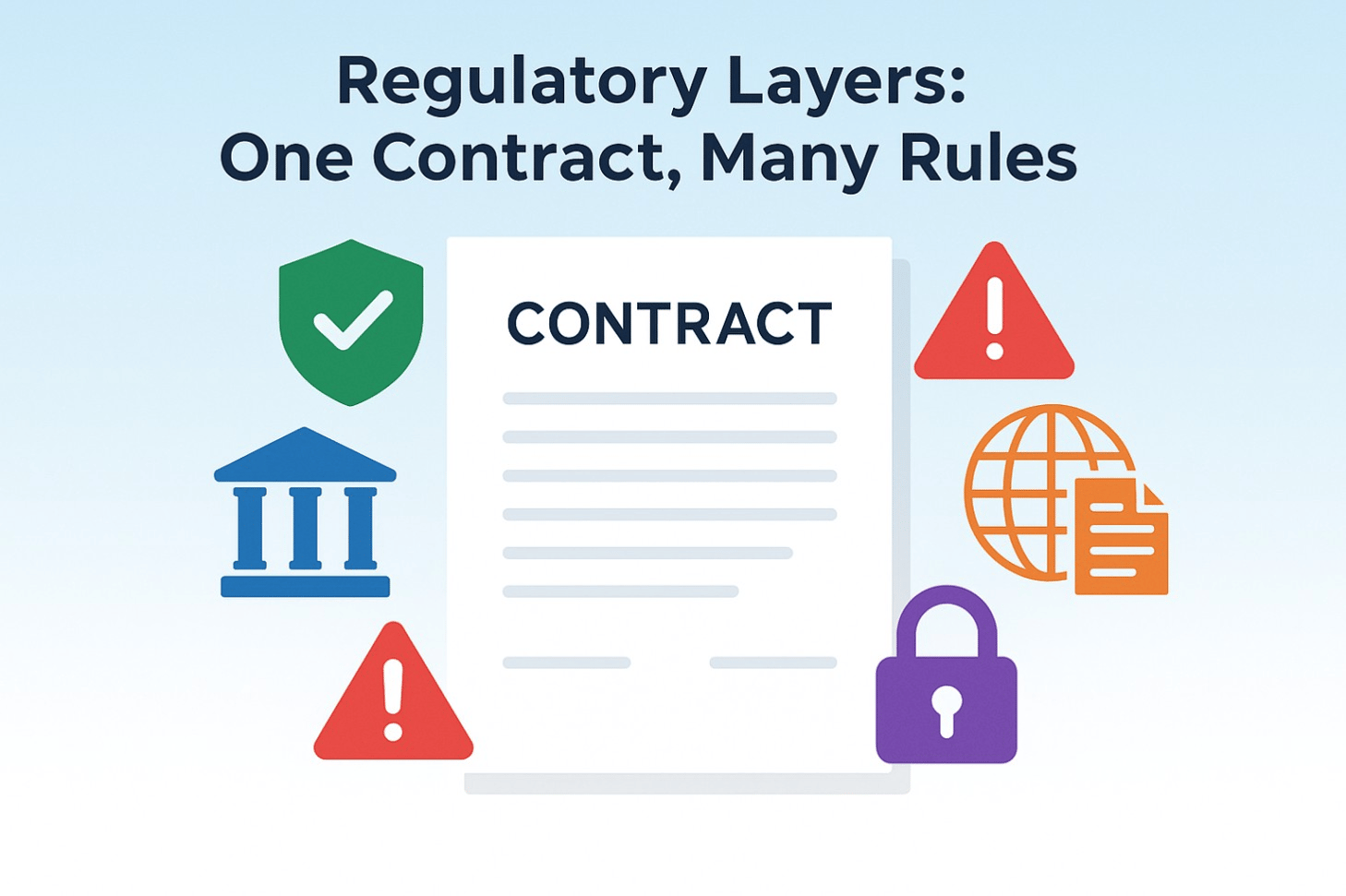
Insurance is one of the most heavily regulated industries globally. For contracts, several regulatory layers come together.
- Consumer protection and fair treatment rules govern policy wording, disclosures, cancellation rights and complaint handling. The NAIC in the United States publishes extensive model laws that aim to protect consumers and standardize insurance contract rules. (content.naic.org)
- Solvency and capital regimes such as Solvency II in Europe require robust governance over underwriting, outsourcers and risk transfer, including reinsurance and critical service providers. (Pinsent Masons)
- Distribution regulations such as the Insurance Distribution Directive set rules for intermediaries, cross border sales and the duties of agents and brokers. (qover.com)
- Data protection and cyber security laws govern how customer and partner data is handled in vendor, TPA and platform contracts.
KPMG and other advisors talk about a dense “regulatory atlas” for insurance, where requirements differ by jurisdiction but interact through cross border business and supervision. (KPMG Assets)
For CLM, this creates several specific complications:
- Contract language must reflect local regulatory specifics. A policy or distribution agreement that is compliant in one country can be non compliant in another, even for the same product. Customer protection papers on digital insurance highlight jurisdictional complexity and patchwork legal frameworks as a central challenge. (Springer Link)
- Regulatory changes require coordinated updates. New model laws, guidance or outsourcing rules often require clause or wording changes across multiple templates and active contracts. Without strong template and clause governance, these changes are tracked in spreadsheets and email threads.
- Regulators increasingly expect evidence. Guidance on outsourcing and documentation emphasizes the need for clear contractual obligations, audit rights and reporting duties in contracts with service providers, not just policies. (Pinsent Masons)
If contract templates and active contracts are scattered across teams and systems, legal and compliance functions struggle to prove that wording changes have been implemented consistently all the way to the customer or partner level. That is a CLM problem, not just a legal drafting problem.
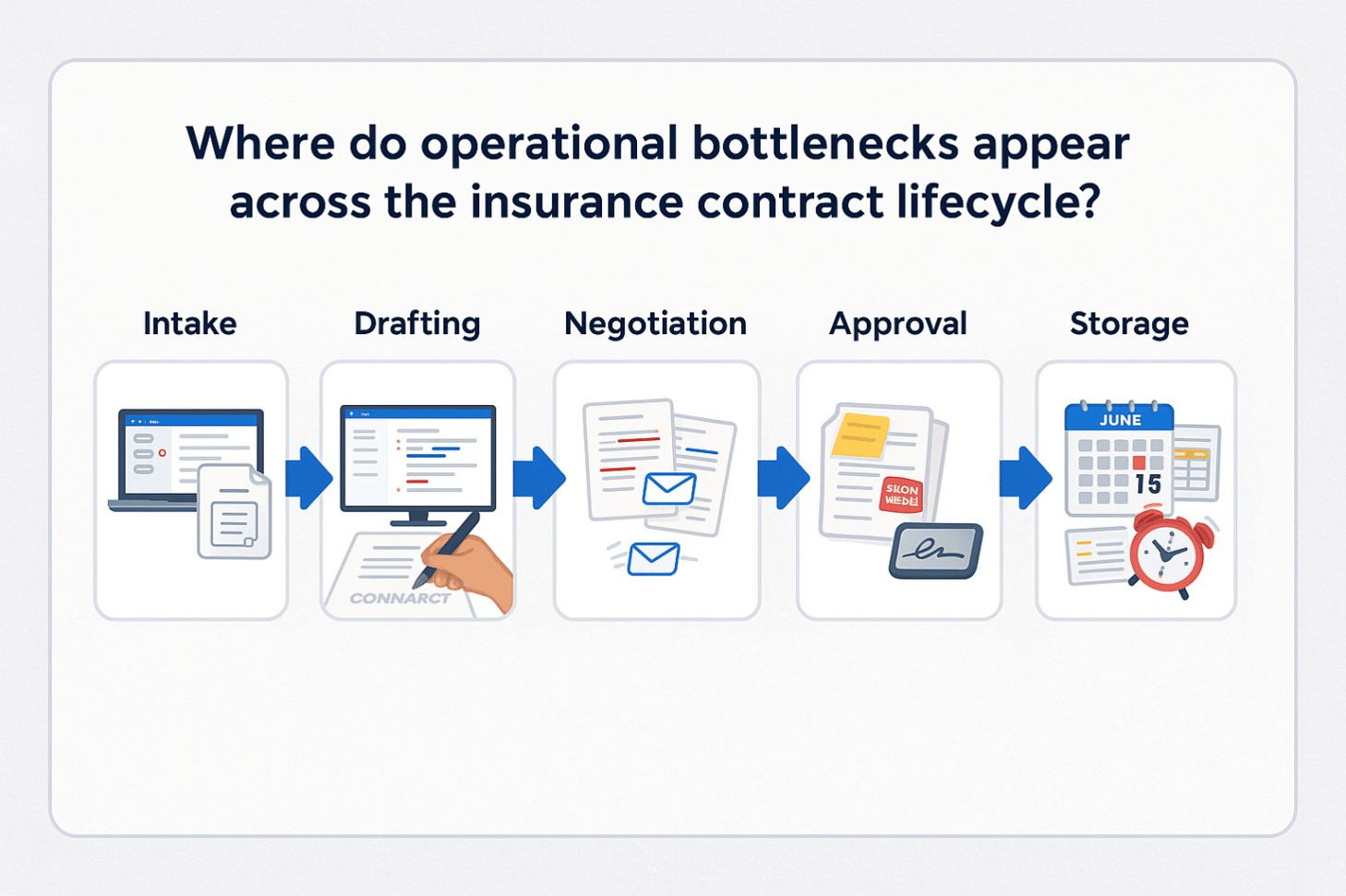
Where do operational bottlenecks appear across the insurance contract lifecycle?
Even when the regulatory picture is clear, the day to day contract lifecycle in an insurer is often slow and fragile.
Intake and drafting
New contracts are frequently initiated via email or manual forms. Underwriters or business owners copy and paste from old documents, adjust clauses by hand and rely on their own collections of “good” wordings. Industry CLM guides describe this copy and paste behavior as a common source of human error and inconsistent terms. (Ivalua)
Negotiation and review
For reinsurance treaties, large corporate policies, provider contracts or strategic vendors, negotiations can involve legal, compliance, underwriting, risk and finance. In many insurers, review still happens through email attachments and tracked changes in Word, with no central redline history or clear indication of the final agreed version.
Gartner and CLM vendors note that contract management software implementations often struggle here, with nearly half of CLM projects failing to meet expectations because workflows cut across so many functions. (Ironclad)
Approval and execution
Approval chains can be long and manual. Signatories vary by contract type, jurisdiction, deal size and risk. Without integrated workflows and a clear approval matrix, teams chase sign offs via email and physical signatures. Some insurers embed standalone e signature tools, but they are not connected to policy admin, claims or CLM, so there is no reliable, end to end audit trail.
Storage and retrieval
After execution, contracts are stored wherever it is easiest for the team involved, which is often not the same place for every contract type. Legal might store negotiated versions in a matter management system. Underwriting keeps local copies. Reinsurance keeps its own files. Operations teams maintain scanned copies in content repositories.
Generic CLM content highlights this “digital filing cabinet” problem for many industries. (Ivalua) In insurance, the impact is amplified when claims or disputes arise and nobody can quickly find, or trust, the right version of a wording.
Monitoring, renewal and change
Key renewal dates, rate review windows, SLAs and audit rights are often tracked in personal calendars and spreadsheets. When a reinsurance treaty, provider contract or outsourcing agreement has a critical option or termination date, missing it can have direct capital, service or risk implications. Reinsurance and regulatory research emphasizes how timing and contract details drive risk outcomes. (Duck Creek Technologies)
Endorsements and amendments are not always linked back to the master agreement in a structured way. Over time, it becomes hard to reconstruct the full contract history.
These operational gaps translate into slower time to market for new products, delayed responses to claims or disputes and higher manual workload across legal, operations and underwriting.
Why is contract data and visibility still so limited in many insurers?
In many insurers, contracts are still treated as unstructured documents rather than as a rich data source. PDFs or scans may be stored centrally, but the data inside them is not consistently captured or linked to core systems.
Healthcare and insurance contract management content points out that without structured data, organizations cannot easily filter contracts by key clauses, obligations or risk factors, and cannot connect contract data to operational performance. (sirion.ai)
For insurers, the missing pieces often include:
- Consistent capture of coverage limits, exclusions, termination rights, rate review mechanisms, audit rights and service level credits.
- A central view of counterparties and their total contractual relationship, for example a hospital that is both a provider and a vendor, or a reinsurer that covers several lines in multiple treaties.
- Reliable linkage between contract data and claims outcomes, network quality or partner profitability.
Without that linkage, insurance leaders struggle to run “what if” analyses across reinsurance treaties or provider networks, or to see which contracts expose them to emerging risks, such as inflation indexed clauses or cyber related exclusions. Risk and resilience reports from McKinsey and others stress that shifting risks and complex interdependencies require better cross contract analytics, not just better documentation. (McKinsey & Company)
When a CLM tool is deployed as a document repository without strong data and reporting capabilities, it becomes a slightly better filing cabinet, not a strategic risk and performance tool. That outcome is common, and it feeds internal skepticism about CLM.
Who actually owns contract lifecycle management in an insurance company?
One of the most under-appreciated CLM challenges in insurance is governance.
- Legal typically owns boilerplates, clause libraries and overall risk language.
- Business units such as underwriting, network management, distribution and procurement own commercial terms and day to day counterpart relationships.
- IT or operations own the systems and integrations that actually move documents and data around.
In practice, this leads to friction:
- Legal is perceived as a bottleneck rather than a partner, especially when workflows and service level expectations are unclear.
- Business units create “shadow templates” in order to move faster, which undermines standardization, makes regulatory updates harder and increases risk.
- No single team feels accountable for CLM outcomes such as cycle time, error rates or audit findings.
Experienced CLM practitioners have noted that implementations often fail when CLM is “owned” by a single function, usually legal or IT, without a cross functional operating model. (LinkedIn)
For insurers, diffused ownership interacts with the contract diversity described earlier. Provider contracts might sit with one executive, reinsurance with another, vendors with a third, and policies with multiple product owners. A CLM initiative framed purely as an IT tool rollout will struggle to change behaviors across this many stakeholders.
A realistic CLM vision for insurance usually requires a clear governance model for templates, clauses, workflows and data, with shared KPIs and an agreed process for change.
Why do generic CLM solutions often disappoint insurers?
Many insurers have already tried at least one generic CLM platform. The pattern of disappointment is consistent:
- Mismatch between tool design and contract reality. CLM tools designed for straightforward sales or vendor contracts in other industries can struggle with high volume policy documents and complex reinsurance or provider agreements that have different structures, data needs and approval paths. Insurance specific content from CLM vendors describes how provider contracting and reinsurance create unique complexity compared to standard buy side or sell side deals. (melento.ai)
- Limited integration depth. If a CLM tool cannot integrate tightly with policy admin, claims, billing, provider systems and content repositories, it becomes another silo. Existing blogs on insurance contract management highlight the importance of central repositories and automation, but often underplay the integration effort needed for insurers with mainframes and multiple core systems. (flowforma.com)
- Inflexible data models. Some horizontal CLM products have rigid data models that assume a small set of contract types and standard fields. Insurance contracts, by contrast, need metadata for risk categories, coverage segments, line of business, regulatory regimes and more. Without the ability to represent those attributes and hierarchies, it is hard to get useful reporting from the system.
The outcome is often the same:
- CLM is used for lower risk vendor contracts, while core insurance contracts remain in legacy systems because migrating them is harder.
- Users revert to old habits such as email, Word and spreadsheets, because workflows feel too generic and not aligned with how underwriting or reinsurance teams actually work.
- Organizations develop “CLM fatigue”, where every new proposal to improve contracts is met with skepticism: “We tried that already. It did not work.”
Analysts and vendors now frequently warn that CLM is not a magic button. Nearly half of implementations fail to meet expectations when complexity is underestimated, preparation is weak and change management is thin. (Ironclad)
For insurers, generic CLM disappoints when it is not configured with insurance specific templates, clause libraries, workflows, metadata and integrations, or when the vendor and internal team do not deeply understand regulated, legacy heavy environments.
How can insurers turn CLM challenges into a realistic improvement agenda?
Recognizing the challenges is not an academic exercise. It is the first step in designing a CLM strategy that has a chance of delivering value instead of frustration.
You can think of your challenge map in six categories:
- Diverse contract landscape. Many distinct contract families with different owners, data and risk profiles.
- Fragmented repositories and legacy systems. Contracts scattered across core systems, shared drives, email, content repositories and print archives.
- Regulatory and compliance complexity. Multiple regulators, cross border supervision, consumer protection, solvency and outsourcing rules that all need to be reflected in wording and proofs. (content.naic.org)
- Operational bottlenecks across the lifecycle. Manual intake, email based negotiation, fragile approvals and ad hoc storage.
- Data and visibility gaps. Contracts treated as documents rather than data, with limited analytics on exposure, obligations and performance.
- Governance and ownership issues. Diffused responsibility and no single owner of CLM outcomes.
Understanding which of these categories hurts you most, and where, explains why generic fixes or one size fits all CLM rollouts have not worked. It also helps you sequence your efforts.
For some insurers, the priority might be reinsurance and treaties, where the capital and counterparty risk is concentrated. Others may focus first on health provider contracts or outsourcing arrangements, where regulators are paying close attention to third party oversight. Others again may start with high volume personal lines where manual contract processes drive operational cost. (McKinsey & Company)
Whatever your starting point, any improvement agenda should:
- Treat CLM as an operating model change, not just a tool.
- Be grounded in a clear map of contract types, systems, owners, risks and pain points.
- Acknowledge the regulatory and cross border context from the outset.
- Assign clear governance and shared KPIs across legal, business and IT.
Platforms like DocPath, which are designed for insurers running on legacy cores and needing both CLM and wider document control, can support that agenda. (global.docpath.com) The key is to define the challenges clearly first, then choose and configure technology with those realities in mind.
FAQs on CLM challenges in insurance
1. What is contract lifecycle management in insurance?
Contract lifecycle management in insurance is the end to end management of all contracts the insurer issues or signs, including policies, endorsements, reinsurance treaties, broker and distributor agreements, TPAs and vendor contracts. It covers drafting, negotiation, approval, execution, storage, monitoring, renewal and termination. (global.docpath.com)
2. Why is CLM harder in insurance than in other industries?
Insurance combines high volume, relatively standardized contracts such as personal lines policies with low volume, high value bespoke contracts such as reinsurance treaties and complex provider agreements. Each contract family has different owners, data and regulatory constraints, and legacy systems are deeply entrenched. Analysts highlight this business complexity as a core driver of higher operating cost and difficulty in standardizing processes. (McKinsey & Company)
3. What are the signs that our CLM approach is failing?
Common signs include repeated difficulty finding the “right” contract version, heavy reliance on email and Word for negotiation and approvals, missed renewal or rate review dates, inconsistent wording across regions after regulatory change and CLM tools that are only used for a narrow set of vendor contracts. Articles on CLM failure note that many organizations experience partial adoption, workarounds and project fatigue when CLM is treated as a technology install rather than a cross functional change. (Ironclad)
4. Do insurers need a separate CLM platform if they already have policy admin and reinsurance systems?
Core systems are good at managing policies, claims or reinsurance accounts, but they are rarely built to handle the full lifecycle of all contract types, including distribution and vendor contracts, with templates, workflows, audit trails and multi channel delivery. CLM platforms for insurance are positioned as the “contract control layer” that sits above core systems and connects to CXM and document generation, which is the approach DocPath describes in its own guidance. (global.docpath.com)
5. How should insurance leaders start improving CLM if they have had failed projects before?
Case studies and advisory content suggest starting with a grounded assessment rather than a new tool shortlist. Map your contract types, systems, owners and pain points. Pick one or two high impact use cases, such as corporate policy renewals or a set of reinsurance treaties, and pilot improved workflows that combine better templates, clearer governance and appropriate technology. Focus on measurable outcomes such as cycle time, error rates and audit findings rather than feature lists. (global.docpath.com)
Seen this way, CLM in insurance is not doomed to fail. It simply needs to start from the real challenges that insurers face and from a clear understanding of where generic approaches fall short.