
Document Software
Designing LATAM-Ready Contract Hubs for Insurers
How LATAM-focused insurers can design contract hubs that align CLM, CCM, and CTC needs.
A readiness guide for banks and insurers on achieving 2026 compliance with Latin America's evolving e-invoicing and real-time tax reporting mandates.
In Latin America, compliance isn’t just “send an invoice PDF.” It increasingly means structured invoice data, near-real-time validation/controls, and end-to-end traceability from the business event to the tax authority response and long-term archiving. EDICOM describes Latin America as the most advanced region for e-invoicing, with electronic documents used across “100% of commercial operations” in major markets like Mexico, Brazil, and Chile. (EDICOM Global)
This guide focuses on the inside-the-enterprise layer that determines success at scale: template governance, numbering, metadata, integrations, monitoring, exception handling, and audit-ready evidence packs, so documents are born compliant across multi-country operations.
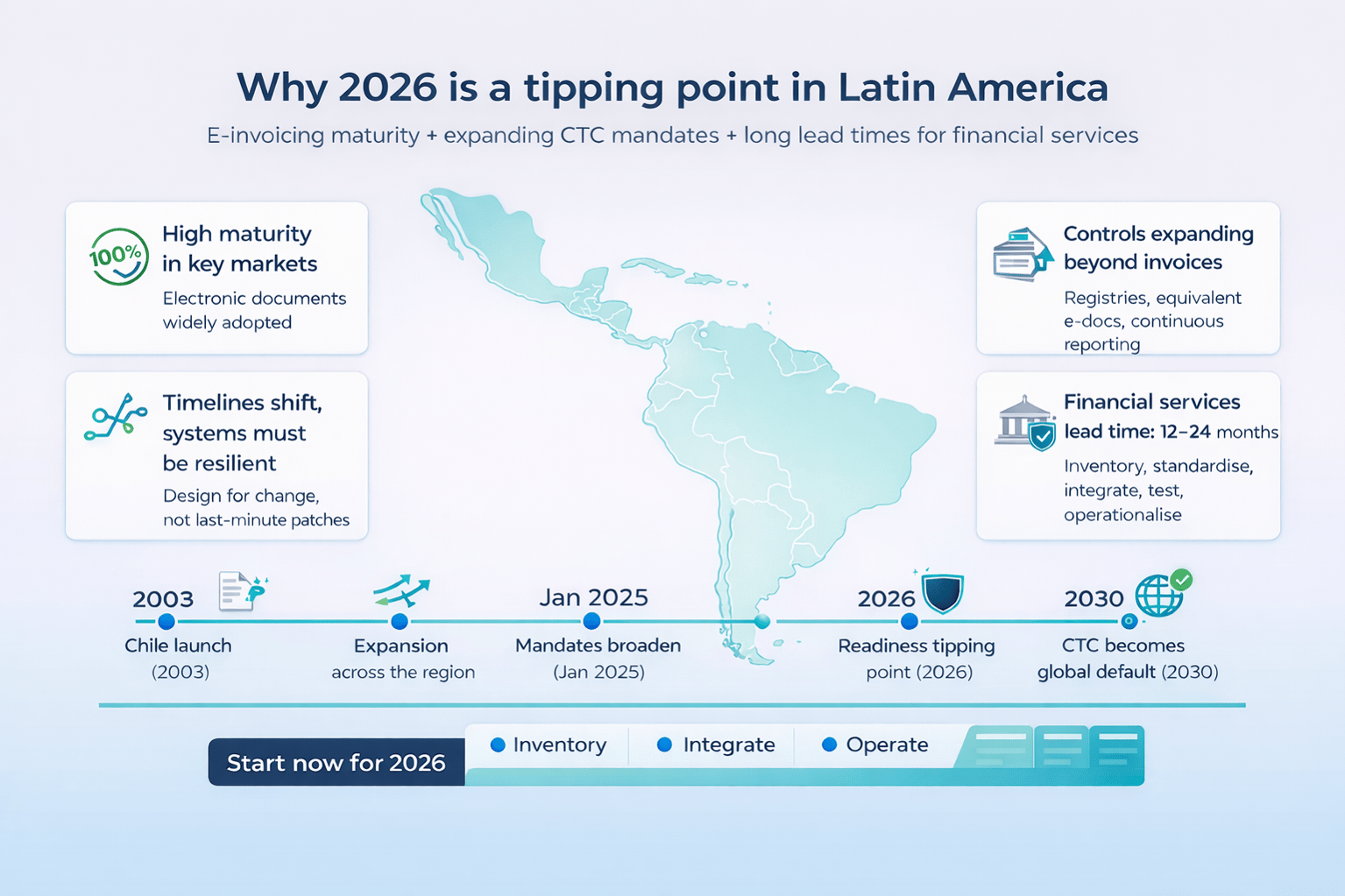
Latin America is often cited as the global reference model for e-invoicing. EDICOM states the region is the most advanced in e-invoicing implementation and notes that in countries such as Mexico, Brazil, and Chile, electronic documents are already used in 100% of commercial operations. (EDICOM Global)
This maturity didn’t happen overnight. CIAT (Inter-American Center of Tax Administrations) explains that e-invoicing was created in Latin America and first launched in 2003 in Chile, then expanded to Brazil and Mexico, driving global adoption over the following decades. (CIAT)
Mandates also continue to expand beyond “invoice issuance” into broader, more continuous controls. Deadlines, document types, and reporting scope keep evolving:
Globally, the direction is clear: OpenText’s 2025 guide states the expectation that by 2030, the majority of the world’s ~200 VAT regimes will have mandatory Continuous Transaction Controls (CTC) around invoices, and notes Latin America as a proven region for these approaches. (OpenText)
What this means for financial services: banks and insurers often need 12–24 months to inventory, standardize, integrate, test, and operationalize across multiple legal entities and countries. 2026 readiness starts now, especially if you run legacy cores, multiple ERPs, or fragmented template ownership.
In plain language: real-time tax reporting and CTC regimes move tax control closer to the moment a transaction happens, so authorities see the data sooner, and businesses must respond faster.
Thomson Reuters explains that e-invoicing mandates are often paired with CTCs that enable governments to collect business transaction data as it is happening (real-time or near real-time), moving away from traditional post-audit reporting where information is gathered long after the transaction. (Thomson Reuters Tax)
Different jurisdictions implement CTCs using different patterns. A useful mental model is:
Pagero’s overview lays out these models and defines CTCs as collecting data from business transaction processes in real time or near real time. (Thomson Reuters Europe)
Colombia is a commonly referenced example of a prior validation model. EDICOM describes Colombia’s system as a DIAN-regulated approach with a “prior validation model,” where the invoice is validated through the tax authority’s system, and implementation requires handling technical specifications and updates. (EDICOM Global)
Systems implication: regardless of which CTC model applies, your architecture must reliably handle structured payloads, response codes, retries, exception workflows, and secure archiving, with evidence that can be reproduced for audit.
Agency acronyms:
For banks and insurers, the “invoice system” is rarely a single system. It’s a document pipeline that often serves multiple document families, many of which share the same template engines, numbering strategies, and metadata plumbing.
Typical families include:
Why financial services are high-risk: volume + regulatory scrutiny + auditability expectations + complex legal-entity structures across countries. In a CTC world, small inconsistencies (IDs, timestamps, mandatory fields, numbering rules) become systematic rejection and reconciliation problems at scale. (Thomson Reuters Tax)
Symptom → root cause examples
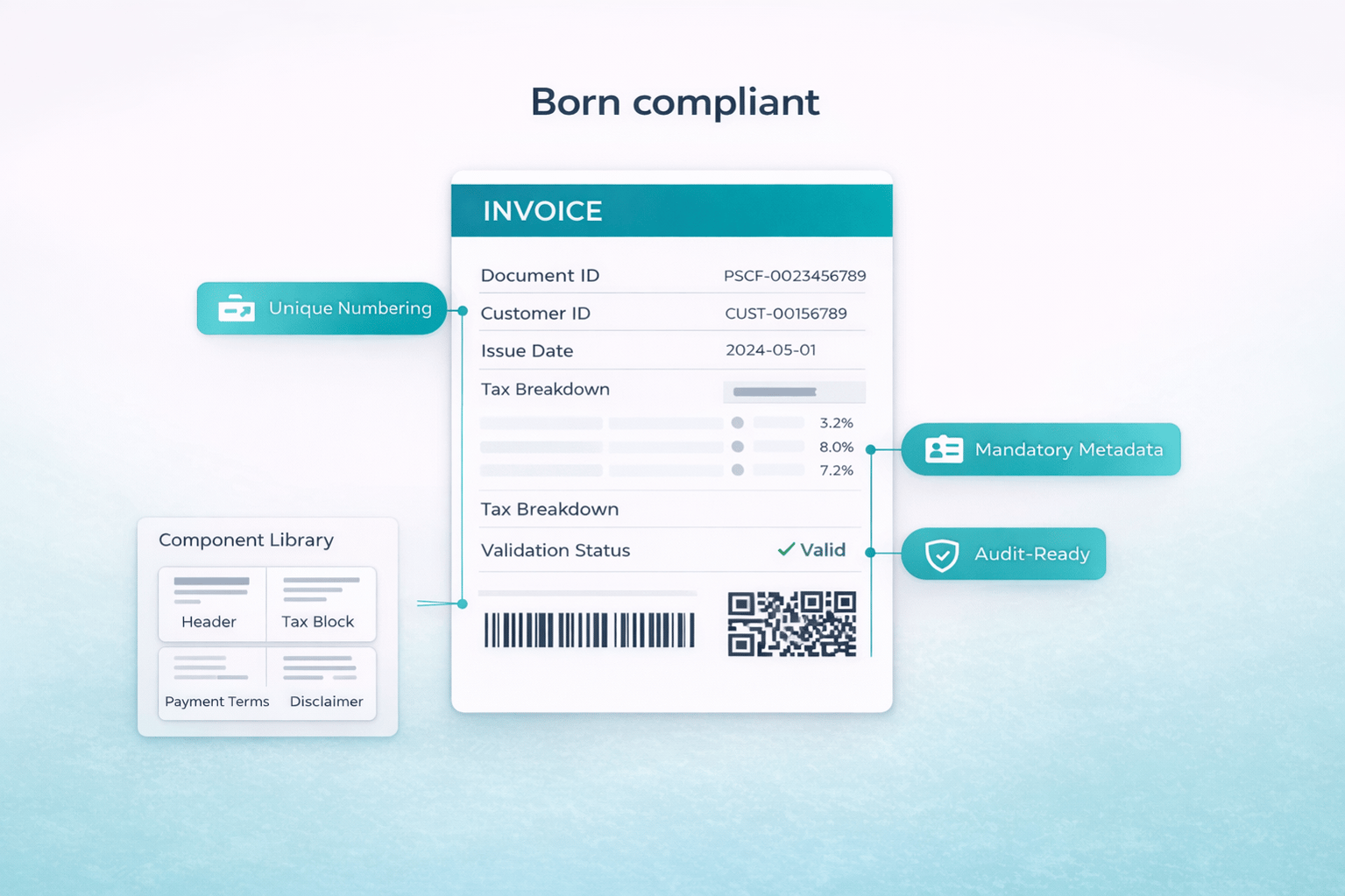 Step 1: Make documents “born compliant” (template + numbering + metadata)
Principle: compliance is cheapest at design time, not at exception time. In real-time/near-real-time controls, you don’t get the luxury of fixing issues weeks later: systems must issue correct documents continuously. (Thomson Reuters Tax)
Start by standardizing what “compliant by construction” means across the enterprise (country-specific rules still apply, but your baseline should be consistent):
Bake into templates and data contracts:
If templates are edited in spreadsheets and emailed around, you will fail at scale. Instead, implement:
A repeatable pattern for South American banks/insurers is:
To avoid template sprawl, build a controlled component library (headers, tax blocks, payment terms, disclaimers) that can be reused across templates and countries. This reduces the “copy/paste fork” problem that creates audit risk.
Change propagation checklist (when new mandates hit)
If you do nothing else, standardize this minimum schema so every document is traceable end-to-end:
This is what makes reconciliations faster and audits survivable, because you can answer “what happened” without hunting through PDFs.
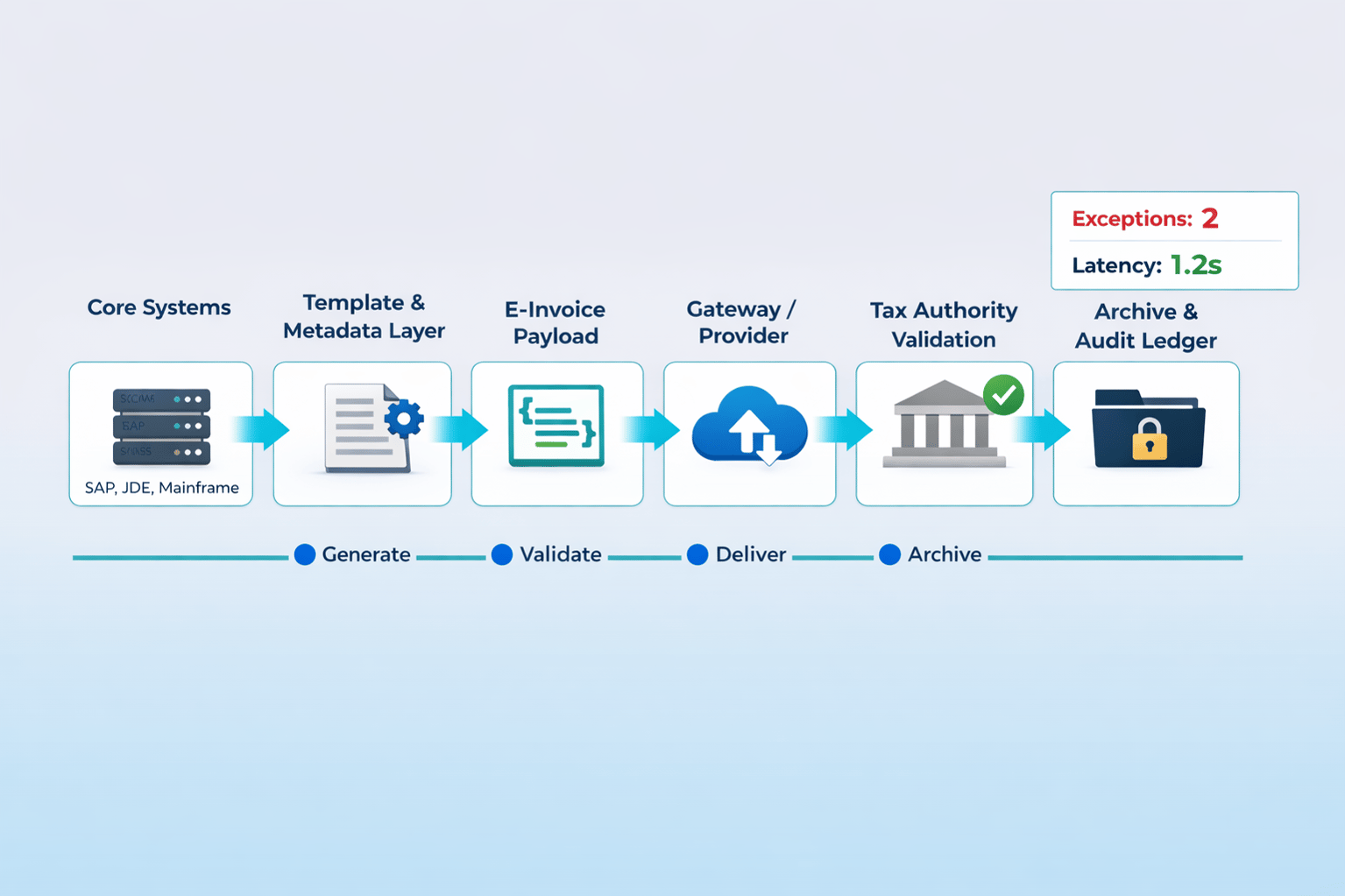
Banks and insurers typically operate mixed estates (SAP, JD Edwards, mainframes, custom cores). The mistake is trying to bolt CTC compliance directly onto each core in a different way, creating a fragile web of country-specific logic.
A practical architecture (described in words):
Core systems (SAP/JDE/mainframe) → document composition + governed template/metadata → structured e-invoice payload → gateway/authorized provider → tax authority validation/receipt → customer delivery → archive + audit ledger
This matches the reality that CTC regimes demand both structured data exchange and traceable lifecycle evidence. (Thomson Reuters Tax)
In real-time or clearance-style regimes, you need production-grade controls:
Whether your country is clearance or real-time reporting, your audit spine should log:
Thomson Reuters notes that CTC frameworks collect data as it is happening and require embedding controls into business processes. These four events form the minimum “what happened when” chain. (Thomson Reuters Tax)
The common issue: legacy cores are optimized for print/PDF output, not structured clearance workflows.
The pragmatic approach is wrap-and-extend:
DocPath, for example, explicitly positions integrations with enterprise platforms including SAP, JD Edwards, and IBM Mainframe, which is the kind of integration reality many financial institutions face. (DocPath)
Traceability is not just compliance theater, it’s how Finance closes faster, how Tax explains variances, and how Audit validates that invoices, adjustments, and customer communications are consistent.
A resilient traceability chain looks like:
contract/policy issuance → billing/accounting event → invoice generated → validation/receipt recorded → delivery proof captured → archived with retention + integrity controls
This aligns with how CTC regimes pull data closer to transaction time and increase expectations for evidence. (Thomson Reuters Europe)
Auditors and regulators commonly ask:
Platforms designed around document lifecycle controls (creation → delivery → signature → archiving) are typically where organizations implement these control layers. DocPath describes its solutions as covering stages of the document lifecycle “from creation to signature and archiving.” (DocPath)
Your goal is to generate an evidence pack on demand, without manual scraping.
A strong 10-item evidence pack includes:
In clearance/pre-validation environments, operational maturity becomes compliance. If validation is near real time, you need real-time operations.
What “good operations” looks like:
EDICOM’s description of prior validation models (e.g., Colombia) underscores why you need strong exception handling: validation rules, technical specs, and responses drive whether an invoice is accepted. (EDICOM Global)
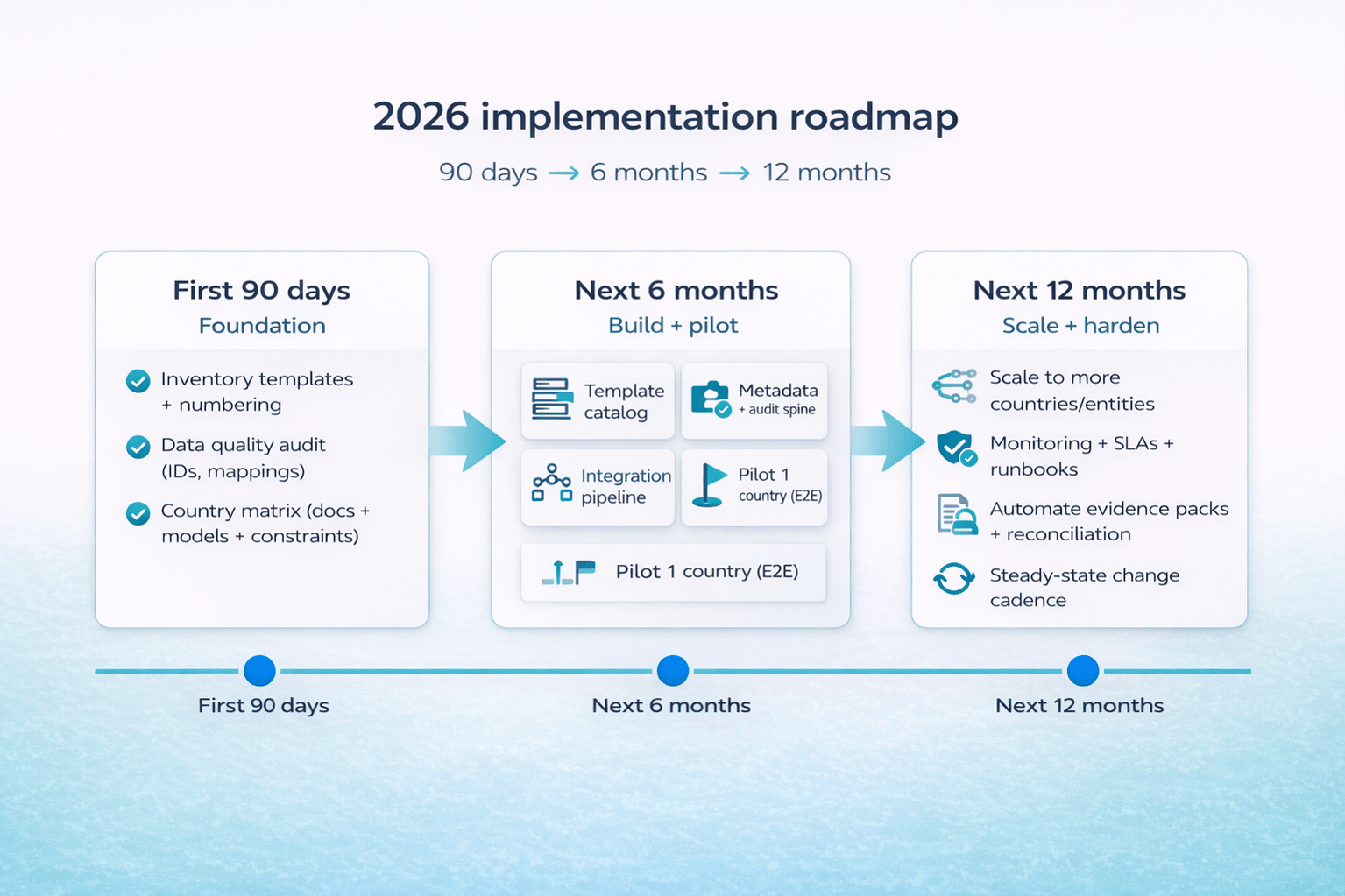
First 90 days (foundation)
Next 6 months (build + pilot)
Next 12 months (scale + harden)
Mini-RACI (who owns what)
Track a small set of KPIs that reflect both compliance and operational health:
These are the patterns that most often cause missed deadlines or chronic operational pain:
This is not a “buy this now” section, just an example of how organizations map capabilities to the readiness steps.
DocPath positions itself around end-to-end document lifecycle coverage: spanning creation → delivery → signature → archiving and includes solution areas like Customer Experience Management (CXM/CCM) and Contract Lifecycle Management (CLM). (DocPath)
Capability mapping (high level):
Ask vendors (and internal teams) questions that map directly to CTC realities:
What’s the difference between e-invoicing and real-time tax reporting (CTC)?
E-invoicing is the electronic issuance/exchange of invoice data, while CTC/regimes push tax control toward real time and authorities collect invoice/transaction data in real time or near real time rather than waiting for post-audit reporting. (Thomson Reuters Tax)
How do I adapt legacy PDF invoice systems to clearance models?
Don’t “teach PDFs to be compliant.” Externalize composition and payload generation into a governed layer that produces both the structured payload and the rendered document from the same data model, then orchestrate validation, delivery, and archiving with event logs. (Thomson Reuters Tax)
How do we manage Brazil/Chile/Colombia/Peru variants without duplicating templates?
Use a master template with country overlays and a shared component library. Keep country-specific rules in overlays and governed data contracts, not copied template forks.
What does “prior validation” mean in Colombia?
It refers to a model where invoices are validated through DIAN’s electronic invoicing system under defined technical specifications; you must handle responses, rule changes, and evidence for acceptance/rejection. (EDICOM Global)
What do auditors need to see to prove end-to-end traceability?
They’ll want status history, template versions, structured payload + validation receipts, delivery proof, and links back to the originating business event (policy/contract/billing) with retention controls.
What are the four events every system should log?
Generate → Validate → Deliver → Archive, each with timestamp, actor/system, and outcome, because CTC frameworks require controls embedded in real-time business processes. (Thomson Reuters Tax)
Why are “equivalent electronic documents” important (beyond invoices)?
Because mandates often expand to additional document types and sectors; for example, Colombia’s Resolution 000119/2024 (as summarized by Comarch) references extensions impacting equivalent electronic documents including areas like banking statements. (Comarch)
How far ahead should we start for 2026 readiness?
If you’re multi-country with legacy cores and high document volume, assume 12–24 months to standardize templates, implement metadata and audit spine, build integrations, and operationalize monitoring, especially as timelines and scope evolve.
Is Latin America really the global benchmark for e-invoicing?
Many sources describe it that way: EDICOM calls it the most advanced region and notes full commercial adoption in major markets; CIAT traces the origin to Latin America starting in 2003 (Chile). (EDICOM Global)
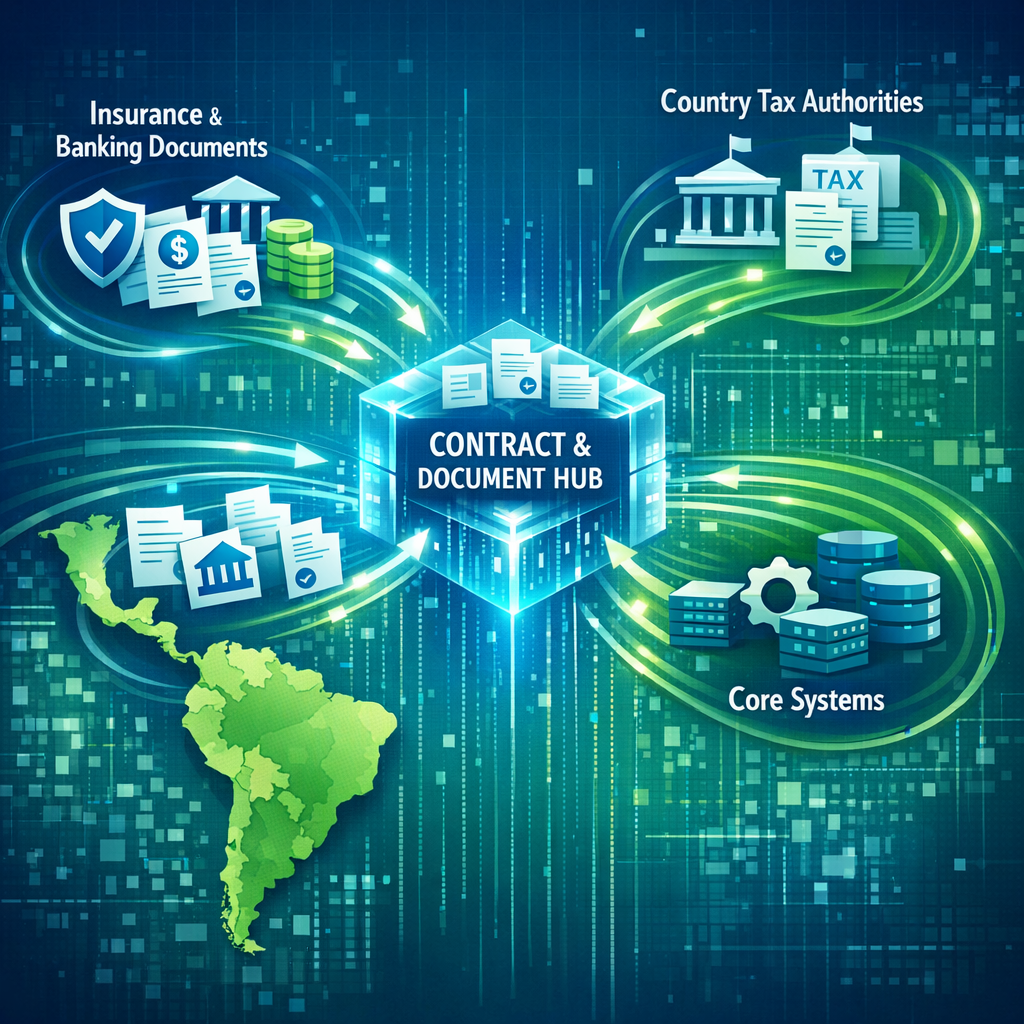
How LATAM-focused insurers can design contract hubs that align CLM, CCM, and CTC needs.

As companies grow, so does the number of invoices they must process. Eight advantages of invoice digitization.

A complete Document Management System with advanced functionalities for fast and easy access to data, in real-time, gives organizations the...