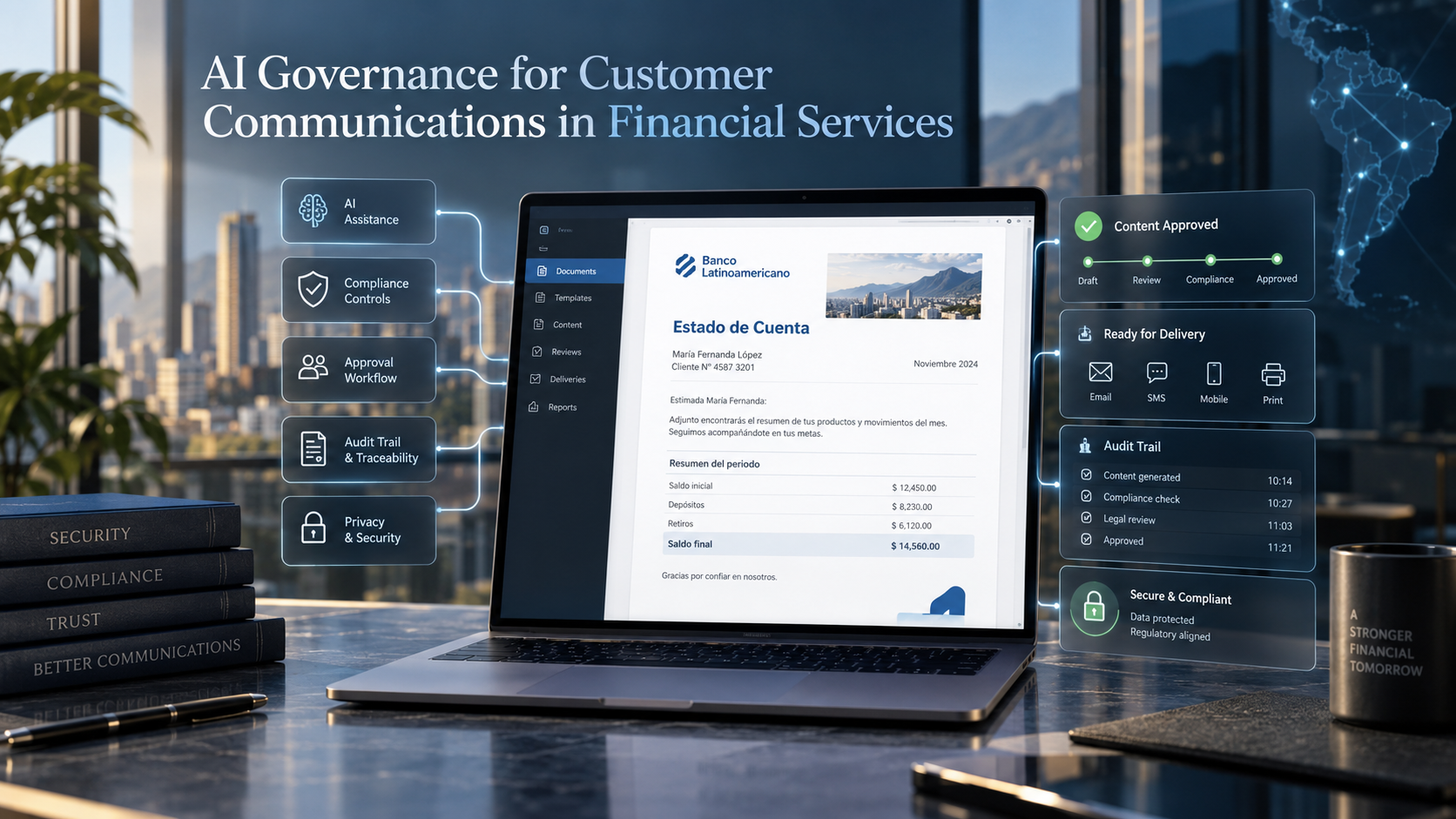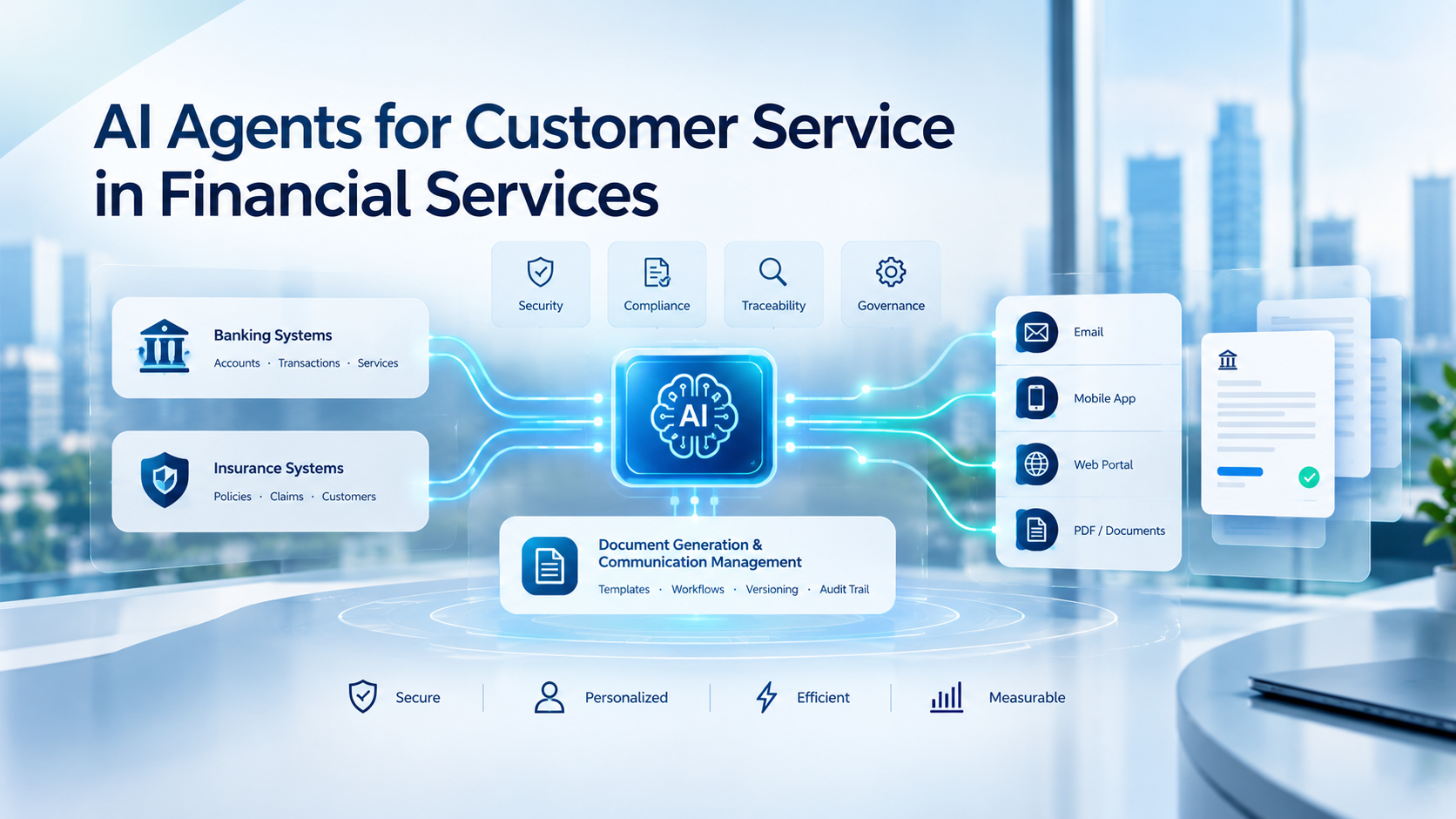
AI agents for customer service in financial services can interpret requests, find approved information, and initiate permitted tasks. Yet an AI agent is not necessarily the system that produces an account statement, issues a policy document, delivers a notice, or records what the customer received. Those outcomes depend on a customer communication layer connecting the agent to governed business processes.
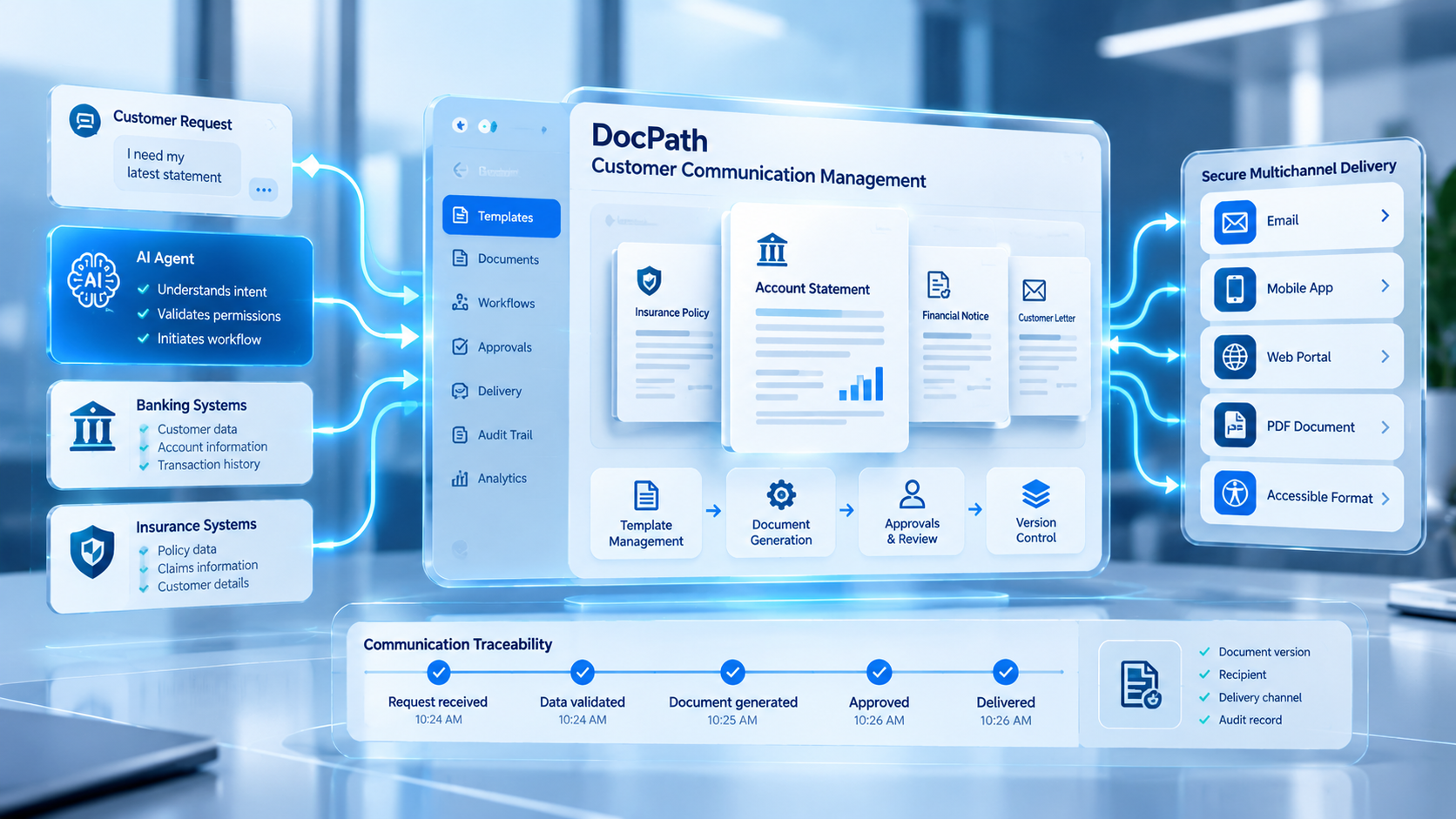
That distinction is central to our approach at DocPath. An agent can coordinate an authorized service step; Customer Communication Management (CCM) controls how the corresponding document or message is composed, approved, delivered, and tracked. Our Customer Experience Management and CCM solutions support these downstream communication activities.
The opportunity is tangible in Latin America. The World Bank's 2025 Global Findex release reported that approximately 70% of adults in Latin America and the Caribbean held a financial account in 2024, with more than half using an account digitally through a card or phone.
For banks and insurers, the question is therefore not merely whether an AI agent can respond. It is whether the institution can complete and document a reliable customer service outcome.
Quick Summary
AI agents in financial customer service are software systems that interpret requests, consult approved sources, and coordinate authorized actions through connected tools. They can help with routine questions, service status updates, and document requests, but they do not replace the systems responsible for producing and governing official customer communications.
A practical deployment connects customer → AI agent → authorized business workflow → CCM → approved delivery and audit record, with human approval or escalation wherever required.
Three principles follow:
- Automate a defined service outcome, not simply a conversational exchange.
- Separate agent authority from communication governance, especially for statements, policies, contracts, and notices.
- Verify the complete journey, including data accuracy, customer authorization, accessible output, delivery, and human handoff.
This guide explains where agents fit, what DocPath's existing banking and insurance deployments demonstrate, and how financial institutions in Latin America can evaluate a controlled pilot.
What Are AI Agents in Financial Customer Service?
An AI customer service agent is a software system that interprets a customer's objective and uses approved information or connected tools to progress a defined task. Depending on its permissions, it may retrieve data, open a case, or initiate a workflow, but it should not invent financial facts or bypass required approvals.
Imagine an authenticated banking customer asking for last month's statement. An agent could identify the request and invoke an approved retrieval process. The bank's systems would determine which account the customer may access, while its document and delivery processes would provide the actual statement.
An agent handles interpretation, tools, permissions, and escalation. The communication layer handles approved templates, accessible output, delivery, and traceability.
Confusing these roles creates a common architectural gap. A convincing answer in a chat window is not proof that the correct financial document was issued or that the institution can reconstruct what happened.
What Makes an AI Agent Different From a Chatbot?
A conventional chatbot usually provides answers or guides users through predefined flows; an AI agent may also coordinate actions through connected tools. The meaningful distinction is the agent's authority and integration scope, not whether the interface uses generative AI.
Consider three service levels:
- Chatbot: Explains how to request an account statement.
- Employee copilot: Prepares the request for a representative to check and approve.
- AI agent: Initiates a narrowly authorized request through connected systems and reports the verified outcome.
More autonomy is not automatically better. We recommend granting only the capabilities justified by the customer's need, the institution's risk assessment, and its ability to reverse or investigate an action.
AI Agents vs. Chatbots vs. Automation: What Changes?
AI agents, rules-based chatbots, employee copilots, and CCM/CXM platforms perform complementary functions. The agent may determine or initiate a service step, whereas CCM manages how official customer-facing content is generated and delivered.
Most institutions should evaluate these as complementary components rather than interchangeable products.
| Dimension |
Rules-based chatbot |
AI copilot |
AI agent |
CCM/CXM platform |
| Main role |
Answers predefined questions |
Supports an employee |
Coordinates permitted tasks |
Governs customer communications |
| Typical action |
Explains branch hours |
Drafts a case summary |
Initiates a statement request |
Generates and delivers a statement |
| Control point |
Approved dialogue |
Employee review |
Tool permissions and action limits |
Templates, approvals, versions, delivery records |
| Main limitation |
Limited flexibility |
Human must take action |
Can act incorrectly if poorly controlled |
Does not replace an autonomous agent |
The table compares functional categories, not specific products or performance benchmarks.
Customer Communication Management (CCM) covers the creation, personalization, distribution, and management of customer messages and documents. Customer Experience Management (CXM) addresses the broader consistency and visibility of customer interactions across touchpoints.
How Can DocPath Support AI-Powered Financial Service?
At DocPath, we support the communication infrastructure that can turn an authorized AI-assisted request into a controlled customer-facing outcome. Our documented capabilities include centralized templates, document generation, multichannel delivery, role-based controls, human review, versioning, and communication traceability.
The important boundary: These are verified DocPath CCM/CXM capabilities, not evidence that we offer a standalone autonomous AI-agent product. Integration with an AI agent would be a separately designed and validated workflow.
Existing customer deployments show why this layer matters:
These cases demonstrate existing document infrastructure, not AI-agent performance or prebuilt connectors. Any proposed agent integration requires separate validation.
What Would an AI-to-Document Workflow Look Like?
An AI-to-document workflow allows an agent to request an authorized service action while enterprise systems and CCM determine the official output. The following example is illustrative, not a description of the Chubb or BBVA deployments.
Suppose a customer requests a duplicate insurance certificate:
- Customer: Submits the request through a service channel.
- Agent: Identifies the document type and initiates the approved process.
- Insurer: Verifies identity, policy entitlement, and the permitted action.
- Core system: Supplies approved policy data and document status.
- CCM: Applies a governed template, generates the certificate, and supports any required review.
- Delivery service: Sends the accessible document through an authorized channel.
- Institution: Records the relevant approval, document version, delivery result, and exception history.
The agent never needs unrestricted authority over document content or delivery. A communication platform such as DocPath could support the generation, workflow, and delivery stages through a project-specific integration.
How Do AI Agents Connect to Financial Service Systems?
AI agents can connect to banking and insurance environments through controlled APIs, approved tools, and business workflows. A robust architecture separates what the agent may request from what core systems may authorize and what the communication layer may issue.
A useful reference architecture is:
Customer → AI agent → authentication and permissions → core banking/insurance or CRM → CCM/CXM → approved channel → delivery evidence.
Banks and insurers should make every customer-visible outcome depend on verified information and a controlled channel.
DocPath lists integrations across insurance platforms, ERP/CRM applications, and core banking ecosystems, as well as connections to SAP, JD Edwards, and IBM mainframe environments. These capabilities support enterprise document workflows; compatibility with any particular AI agent requires technical assessment.
In BBVA's documented deployment, we modernized document generation without modifying banking applications and centralized template control.
A proposed AI integration should preserve that continuity and control.
Why Must an Agent Use Approved Customer Information?
Financial AI agents should obtain balances, fees, policy terms, statuses, and contractual details from authoritative sources instead of generating plausible but unverified values. The communication workflow should preserve approved wording and traceable versions whenever the output has legal or financial significance.
Our recommended source controls are straightforward:
- Maintain approved, current knowledge and document templates.
- Enforce customer-specific authorization before retrieval.
- Use core systems for financial values and calculations.
- Require review when information conflicts or a mandatory disclosure applies.
- Retain the relevant output and workflow evidence.
Retrieval-augmented generation can provide source material but cannot substitute for source validation or permission checks. NIST recommends governing and measuring AI risks throughout the lifecycle.
Exploring AI-powered customer service? Contact DocPath to discuss the communication workflows, document generation, and enterprise integrations that may support your architecture.
Which Financial Customer Service Tasks Can AI Agents Handle?
For a first deployment, we recommend well-defined service requests that can be verified against approved information and completed within clear permissions. Banks and insurers can prioritize information requests and service coordination before considering higher-impact financial actions.
Recent regional evidence shows why customer-facing workflows deserve attention. Deloitte and FEBRABAN's 2026 banking technology research reported that 83% of Brazil's 240.8 billion banking transactions in 2025 were conducted through digital channels. This measures channel usage, not the adoption of AI agents.
In the separate 2025 FEBRABAN survey, more than eight in ten participating Brazilian banks reported incorporating generative AI into operations, although that does not establish adoption of autonomous customer service agents.
| Customer request |
Suitable agent contribution |
Communication or control requirement |
| “Where is my statement?” |
Initiate approved retrieval |
Identity check, correct file, secure delivery |
| “What's my claim status?” |
Retrieve and explain status |
Verified policy data, approved language |
| “How do I update my address?” |
Guide or initiate a permitted workflow |
Authentication and change confirmation |
| “I want to dispute a charge.” |
Collect facts and route the case |
Human review and established dispute process |
| “Which documents do I need?” |
Explain approved requirements |
Current, localized templates and instructions |
These hypothetical use cases still require documented eligibility, reliable data, and human escalation.
Which Service Requests Should Remain Human-Led?
Disputed financial decisions, suspected fraud, exceptional complaints, and requests affecting customer rights call for stronger human involvement. An agent may collect information or arrange a handoff, but it should not be assumed to possess the authority to decide these cases.
In the Bank of England and FCA's 2024 financial-sector AI survey, 55% of reported AI use cases involved some automated decision-making, but only 2% were fully autonomous. These results cover UK financial services AI broadly, not Latin American customer service agents.
We recommend qualified employees handle contested credit explanations, complex claims, fraud reports, and vulnerable-customer cases, with a clear explanation of the next step.
How Do You Choose the First AI Agent Use Case?
The best first use case is frequent, predictable, supported by reliable source data, and low in potential customer harm. Institutions should also be able to authenticate the requester, verify the outcome, and transfer unresolved cases to people.
We recommend scoring candidates against this proposed DocPath readiness rubric. It is a planning aid, not a regulatory standard.
| Criterion |
0: Not ready |
1: Partial |
2: Ready |
| Source information |
Missing or unreliable |
Partially checked |
Current and verified |
| Workflow clarity |
Unmapped |
Some steps documented |
End to end, with exceptions |
| Permissions |
Undefined |
Some restrictions |
Explicit least privilege |
| Customer impact |
High or irreversible |
Review can mitigate |
Low-risk and reversible |
| Human escalation |
No path |
Manual workaround |
Tested handoff |
Add the scores for an indicative total out of 10. A use case with weak permissions or no reliable escalation should not launch merely because its overall score is high.
Document retrieval may be a better starting point than changing payment instructions. Expand authority only after a controlled workflow succeeds.
When Should an AI Agent Transfer to a Human?
An agent should escalate when authorization fails, authoritative sources conflict, a customer contests an outcome, or the required action exceeds its permitted scope. The handoff should preserve relevant context without exposing more personal information than the receiving team needs.
Define the trigger and destination in advance:
- Security: Failed authentication or suspicious activity.
- Accuracy: Missing, outdated, or conflicting information.
- Authority: A requested action outside agent permissions.
- Impact: Material financial consequences or customer vulnerability.
- Service quality: Repeated failure to achieve a verified resolution.
Escalation is part of successful service design, not evidence that the technology has failed.

How Do You Implement AI Agents in Financial Services?
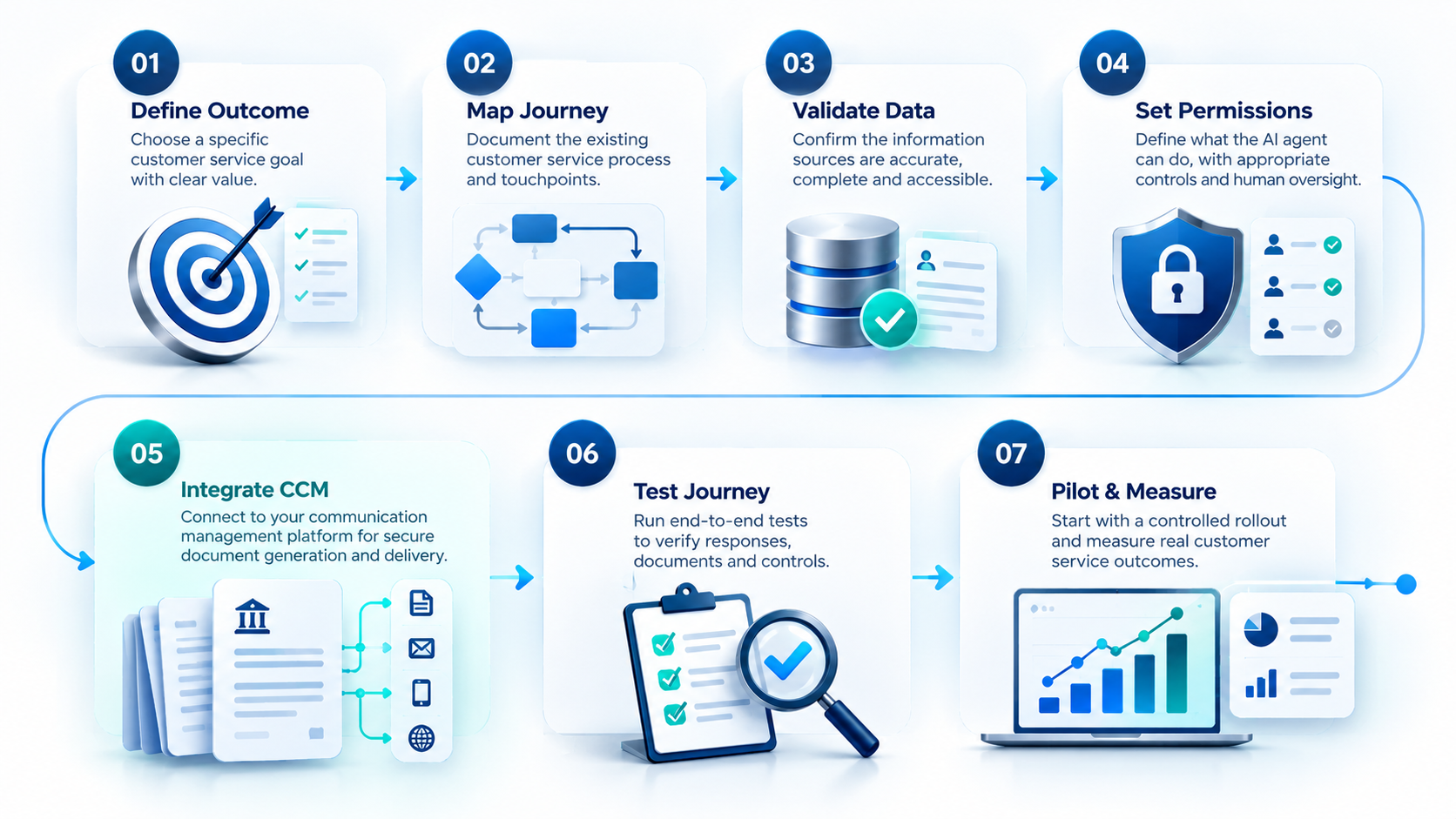
We recommend implementing AI agents through a controlled process that begins with the customer outcome and ends with evidence that the outcome was achieved. Our recommended sequence keeps the AI layer, enterprise systems, CCM, and human teams accountable for their separate responsibilities.
The Financial Stability Board's 2026 final report identifies 12 sound practices for responsible AI adoption by financial institutions, focused on governance and risk management throughout the AI lifecycle. The practices are guidance, not an automatic substitute for national legal requirements.
Step 1: Select one service outcome. Define precisely what constitutes completion, such as an authorized customer receiving the correct statement.
Step 2: Map the current journey. Identify customer touchpoints, source systems, approvals, document templates, delivery channels, and failure paths.
Step 3: Validate approved data and content. Assign owners to policy information, knowledge sources, and templates. Establish how updates will be approved and synchronized.
Step 4: Set permission and escalation boundaries. Separate read-only tasks from actions that modify records or move funds. Define identity checks, approvals, refusal rules, and a reliable human handoff.
Step 5: Integrate the communication layer. Connect the agent's authorized request to enterprise workflows and governed document generation. Confirm how templates, accessible outputs, channel preferences, and evidence will be handled.
Step 6: Test the complete journey. Evaluate routine and unusual requests, prompt injection, failed authentication, inconsistent data, localization, accessibility, and interrupted deliveries. Verify the final customer-visible output, not just the AI response.
Step 7: Pilot and measure. Compare verified resolution, repeat contacts, cost, errors, escalations, and complaints with the baseline. Expand only when the institution meets documented acceptance criteria.
Customer operations should own the service; risk teams, IT, and communication owners should govern their respective controls.
What Should a First AI Customer Service Pilot Deliver?
A pilot should demonstrate repeatable completion of a narrowly defined customer task, including correct documents, authorization, and delivery. A convincing conversation is insufficient if the downstream action fails.
Require six tangible outputs: an approved process map, source inventory, permission model, representative test set, escalation procedure, and KPI dashboard. Test both successful interactions and deliberately problematic scenarios.
Document unresolved exceptions, owners, shutdown procedures, and evidence supporting expansion.
What AI Agent Risks and Rules Matter in Latin America?
Financial institutions in Latin America need to manage AI-related data, security, customer-impact, and communication risks alongside applicable national financial and privacy rules. One regional technical architecture can support several markets, but legal requirements must be mapped by country and use case.
For this article, we recommend a concise four-part risk framework:
| Risk |
Operational control |
Communication-layer check |
| Incorrect information |
Approved sources and tested calculations |
Verified template and mandatory wording |
| Unauthorized access or action |
Authentication, least privilege, approval gates |
Appropriate recipient and delivery channel |
| Unsafe autonomous behavior |
Tool restrictions, monitoring, human escalation |
Hold or review sensitive outputs |
| Missing evidence or accessibility |
Traceability and output testing |
Record document version, delivery, and accessibility checks |
OWASP's 2025 agentic AI security guidance identifies tool misuse, agent-goal hijacking, and identity or privilege abuse among the risks that warrant control.
Rather than repeat a comprehensive regulatory inventory here, our dedicated AI governance in financial customer communications guide covers the wider controls, jurisdictions, and evidence requirements.
Why Do Banks Need Country-Specific AI Governance?
Latin American markets do not share a single privacy or AI law. Institutions should confirm applicable financial conduct, consumer rights, data protection, and automated-decision rules with local specialists before enabling a particular agent action.
A compact jurisdiction check highlights the differences:
For document-specific obligations, see our guide to compliant banking communications in Latin America.
Deploying across markets? Contact DocPath to discuss governed customer communications and document workflows that can support a jurisdiction-aware implementation.
How Can AI Customer Service Remain Accessible?
Accessible AI customer service must work for customers who use assistive technologies or need alternative ways to interact. It should cover the conversation, identity checks, service instructions, and the documents ultimately delivered.
The broader digital accessibility gap remains visible. WebAIM's 2025 assessment of one million popular homepages found automatically detectable WCAG failures on 94.8% of the pages assessed. This is a cross-industry web study, not a measurement of banking AI systems.
We recommend testing the whole journey for keyboard access, screen-reader announcements, understandable errors, accessible authentication, language settings, and a usable path to human assistance. A Spanish or Portuguese interaction should also preserve clear terminology in any resulting document.
The W3C's WCAG 2.2 guidance provides criteria covering many of these interface and interaction requirements.
Why Do Accessible PDFs Matter in AI-Assisted Banking?
An agent may resolve a request conversationally yet fail the customer's practical needs if the resulting statement or notice is inaccessible. Document accessibility is therefore a production and validation requirement, not just a chatbot design preference.
ISO 14289-2:2024, known as PDF/UA-2, addresses accessible PDF structure and use.
Our Accessibility & Inclusion offering supports accessible-PDF generation within document workflows, and our guide to accessible PDFs at scale discusses template governance and validation.
Institutions should test real outputs for reading order, table semantics, document language, and assistive-technology usability. A tool's capabilities alone do not guarantee that each resulting file meets every legal or accessibility requirement.
How Do You Measure AI Customer Service Performance?
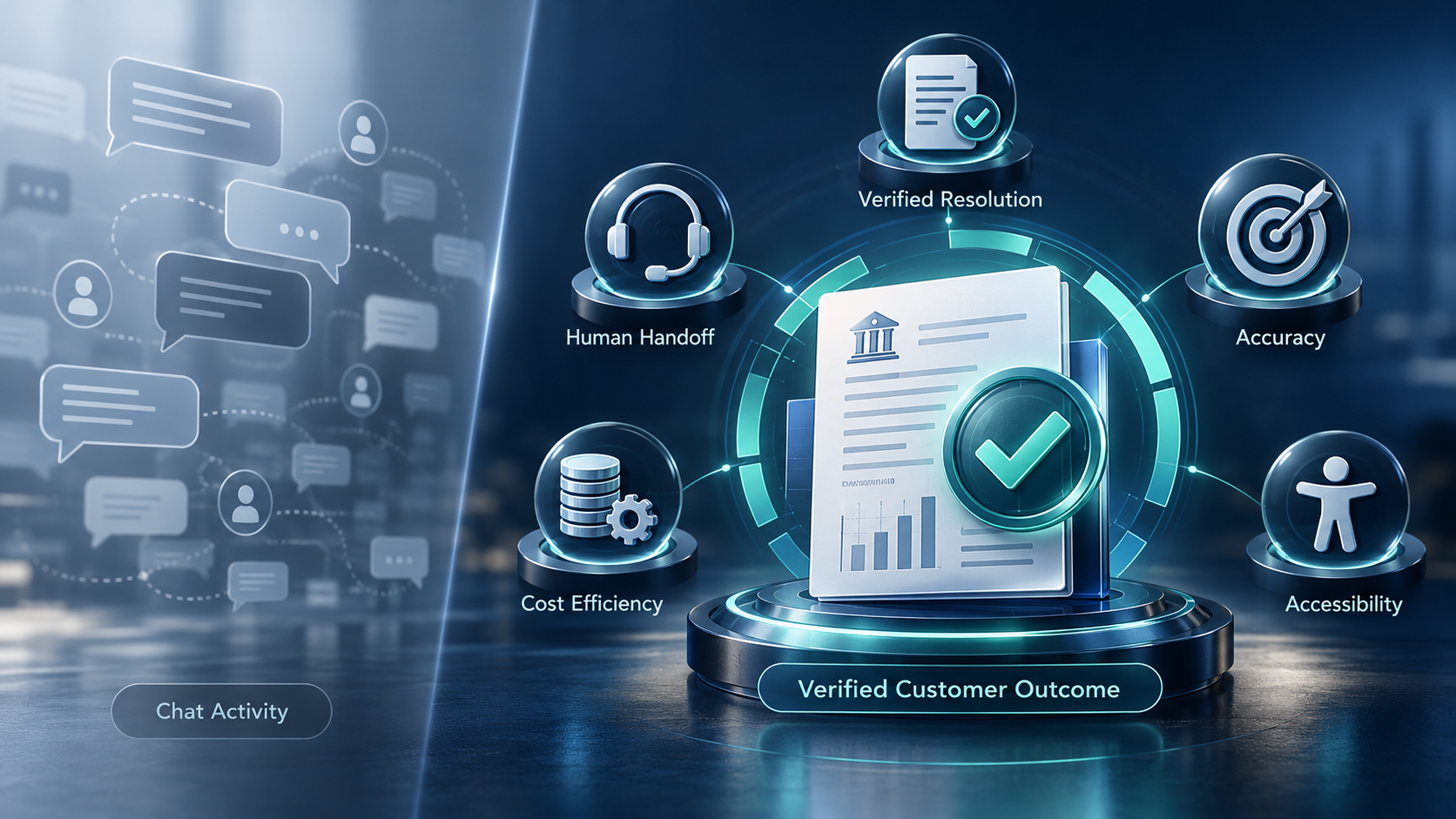
AI customer service performance should be measured by completed customer outcomes, not simply chatbot engagement or avoided human contacts. Financial institutions need metrics for resolution, errors, cost, safety, and the quality of the resulting communication.
We recommend defining eligible requests and the observation period before measuring the pilot:
| KPI |
Suggested definition |
Why it matters |
| Verified resolution rate |
Confirmed completions ÷ eligible requests |
Measures actual outcomes |
| Human handoff rate |
Transferred cases ÷ agent-handled cases |
Reveals escalation demand |
| Repeat-contact rate |
Related repeat inquiries ÷ eligible cases |
Detects unresolved needs |
| Cost per verified resolution |
Total attributable cost ÷ confirmed completions |
Shows unit economics |
| Factual error rate |
Materially wrong answers ÷ evaluated answers |
Tests information quality |
| Unauthorized-action rate |
Confirmed unauthorized actions ÷ attempted actions |
Tests permission safety |
| Accessibility pass rate |
Outputs passing the test plan ÷ tested outputs |
Measures inclusive delivery |
These are proposed operational definitions. Teams should document sampling, exceptions, severity, and verification rules before comparing results.
The critical check is whether the authorized customer received the correct, usable document through an approved channel.
For context, FEBRABAN's 2025 survey of Brazilian banks reported an average 11.4% increase in process efficiency following adoption of AI and generative AI among participating institutions. That is a reported broader process-efficiency measure, not evidence of returns from autonomous customer service agents or from DocPath installations.
How Should Financial Institutions Calculate AI Agent ROI?
AI agent ROI should compare documented benefits with all relevant costs of building and operating the service. It should reflect verified resolutions rather than assuming every automated response replaces employee work.
A consistent calculation is:
ROI (%) = [(Verified gross benefits − Total costs) / Total costs] × 100
Include integration, model usage, security testing, human review, document generation, accessible-output validation, maintenance, and incident handling in total costs. Count savings only when supported by operational and financial records, and avoid counting the same benefit twice.
What Mistakes Should Banks Avoid When Deploying AI Agents?
Banks should avoid giving an AI agent responsibility for an end-to-end outcome without controlling the systems that authorize actions and communicate results. The clearest prevention strategy is to validate the full service journey before expanding automation.
| Pitfall |
Potential consequence |
Better approach |
| Automating high-impact decisions first |
Customer harm or difficult reversals |
Start with bounded, low-risk tasks |
| Using unverified content |
Incorrect terms, balances, or explanations |
Use approved systems and templates |
| Giving broad tool access |
Unauthorized action or data exposure |
Enforce restricted permissions |
| Ignoring the CCM layer |
Wrong document, recipient, or version |
Govern generation and delivery |
| Omitting human escalation |
Unresolved disputes and complaints |
Test the handoff pathway |
| Counting chats as resolutions |
Misleading performance reports |
Verify completed outcomes |
| Skipping accessibility |
Unusable communications |
Test interfaces and documents |
These mistakes overlap with OWASP's agent security guidance and the FSB's 2026 sound practices.
BBVA illustrates version control, while Chubb illustrates modular document production. Neither published case validates an AI-agent rollout.
Is Your Financial Institution Ready for AI Agents?
A financial institution is ready for a controlled pilot when it can define the customer task, authorize every action, verify its underlying data, and produce a governed customer communication. The readiness test should include what happens when the agent cannot complete the request.
Use this checklist before launch:
- One low-risk service outcome and its eligible customer group are defined.
- The current process, connected systems, and exceptions are mapped.
- Authoritative data sources and document templates have owners.
- Identity, permissions, and action boundaries have been approved.
- CCM generation, review, delivery, and traceability are tested.
- Human handoff and rollback procedures work.
- Country-specific obligations have been reviewed.
- Relevant Spanish and Portuguese interactions are tested.
- Interfaces and generated documents are accessibility-tested.
- Pilot metrics and go/no-go criteria have been agreed.
The final question is: Can we prove the right customer received the right information through the right authorized process? If not, fix the workflow before expanding authority.
Building the communication foundation for financial AI agents? Contact DocPath to discuss document automation, accessible customer communications, and enterprise integration requirements.
Frequently Asked Questions About AI Agents in Financial Services
AI agents require clear boundaries between automated actions and official communications. These answers address common planning questions.
1. How are AI agents different from traditional banking chatbots?
Traditional chatbots usually answer questions or follow configured flows, while AI agents may access approved tools to progress authorized tasks. Neither technology should be given more access than the use case requires.
2. Which customer service tasks should banks automate first?
Start with frequent, low-impact requests such as service status checks, approved document retrieval, and appointment scheduling. Choose tasks with current source data, clearly mapped steps, verifiable outcomes, and reliable human escalation.
3. Can AI customer service agents access accounts or transfer money?
Only if the financial institution explicitly permits those functions and implements the required authentication, authorization, and safeguards. A conversational request must not, by itself, authorize unrestricted access or transfers; high-impact transactions deserve particularly stringent controls.
4. What regulations apply to AI customer service in Latin America?
Requirements vary by country and use case, including privacy, financial conduct, consumer protection, security, and automated-decision rules. Institutions should confirm applicable obligations locally instead of treating Latin America as one legal jurisdiction.
5. How much does an AI customer service agent cost?
Total cost depends on models, transaction volumes, system integration, security, testing, staff oversight, and the communication infrastructure. Compare the fully loaded cost per verified resolution with the current process rather than relying on generalized automation savings claims.
6. Why is document accessibility important for AI banking agents?
A customer may need a generated statement, certificate, or notice to finish an AI-assisted interaction. If that document cannot be used with assistive technology, a fast conversational response has not produced an accessible end-to-end service outcome.